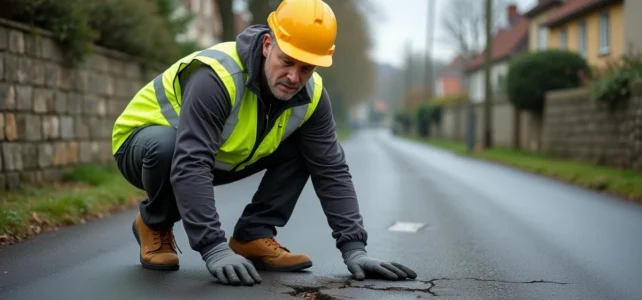
The maintenance of municipal roads represents the primary investment item for many rural municipalities, yet the disparities in resources between local authorities are considerable. The gap between financial capacity and actual needs underpins the entire issue of managing municipal roads in France.
Actual cost of maintenance per kilometer: what budgetary discrepancies reveal
The available data allows us to measure the extent of the problem. In many small municipalities, the actual expenditure per kilometer of road remains well below the usual technical recommendations.
The ratio between actual budget and necessary budget illustrates a chronic under-investment. At this rate, a small municipality cannot adhere to the recommended repair cycle, which accelerates the deterioration of road surfaces and increases future costs.
When these observations are related to the reality on the ground, managing municipal road maintenance first requires accurately quantifying this gap between resources and needs, municipality by municipality.
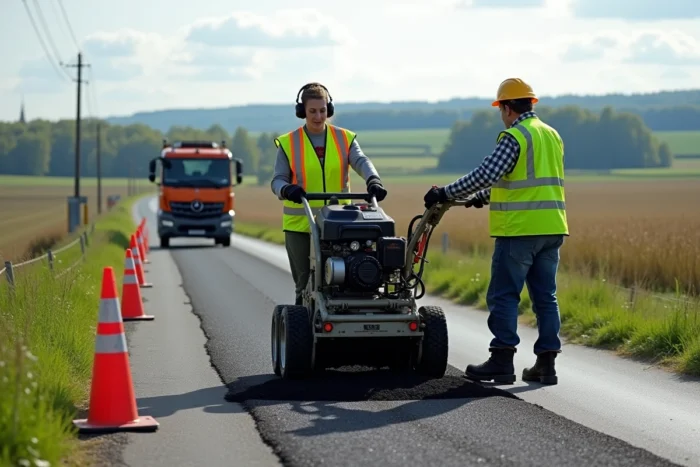
State allocations and road financing: what is changing for rural municipalities
Neither the general operating grant (DGF) nor the rural territory equipment grant (DETR) is currently sufficient to cover the road maintenance deficit of small municipalities. The removal of the housing tax has further reduced the financial leeway of the most modest local authorities.
Two recent developments deserve particular attention.
Support grant for rural amenities
The organic report on local public finances presented to the National Assembly indicates that this grant has been increased to 100 million euros in 2024, a sum that has been multiplied by twenty compared to 2019. It values the environmental services provided by rural municipalities (biodiversity, landscape, ecological continuities).
This fund can indirectly support road requalification projects that incorporate landscape or shoulder management issues. It is a lever that few municipalities spontaneously identify for their road works.
Investment fund project for territories
The same report notes that the 2026 finance bill plans to consolidate major investment grants (DETR, DSIL, DPV) into a single fund called the investment fund for territories (FIT). This consolidation aims to simplify grant applications for municipalities, but it remains to be seen whether the overall funds will increase or if administrative simplification will occur at a constant budget.
Water, heatwaves, and deterioration: the technical factors impacting road management
Beyond financing, the lifespan of a municipal road depends on physical factors that local elected officials must integrate into their work programming.
Water remains the primary cause of road surface deterioration. Untreated infiltrations weaken the internal structure of the pavement, causing subsidence and accelerating the formation of potholes. Preventive maintenance of drainage networks (ditches, gutters, inspection chambers) is significantly cheaper than a complete road resurfacing.
Heatwave episodes are an increasingly documented factor of deterioration. Some municipalities observe pavement deformations during prolonged periods of high heat, a phenomenon that adds to the classic winter damage (freeze-thaw).
- Drainage and maintenance of ditches: the first preventive action to schedule each year, even before surface works.
- Regular visual inspection: identifying cracks and emerging subsidence allows for targeted maintenance techniques (patching, surface treatment) before deterioration reaches the structure.
- Choosing the appropriate surface material for traffic: an agricultural access road does not require the same pavement as a town center street, and calibrating this choice reduces lifecycle costs.

Multi-year programming of road works: an underutilized management tool
Most municipalities manage their roads on an ad-hoc basis, reacting to emergencies. This approach is more expensive in the medium term than a structured multi-year program.
A multi-year maintenance plan categorizes each section according to its actual condition and allows for prioritizing interventions. Municipalities that adopt this method allocate their budget more effectively: they concentrate resources on sections where early intervention prevents heavy resurfacing, and they defer work on roads that remain in acceptable condition.
The preliminary diagnostic approach involves examining the state of the network, identifying maintenance obligations, and visualizing the extent of the road asset before deciding on expenditures.
For municipalities that do not have a dedicated technical service, departmental technical agencies offer support for these diagnostics. Several departments have structured support services that pool expertise among small municipalities in the same territory.
Sidewalks and accessibility: an often-overlooked aspect of municipal roads
Road management is not limited to road surfaces. Sidewalks represent a safety and accessibility issue for pedestrians, people with reduced mobility, and users of soft modes of transport.
A deteriorated sidewalk, with slabs raised by roots or sunken curbs, poses a fall risk and engages the municipality’s liability. Sidewalk maintenance falls under the same obligation as road surfaces, but it is often relegated to the background due to budget constraints.
Integrating sidewalks into the multi-year road plan allows for addressing this issue coherently, without separating it from the rest of the network.
Funding remains the main barrier to managing municipal roads. Municipalities that combine technical programming with active searches for suitable grants (rural amenities, future FIT) have a real lever to break free from the cycle of deterioration. A precise diagnostic of the network, section by section, remains the first step before any budgetary decision.