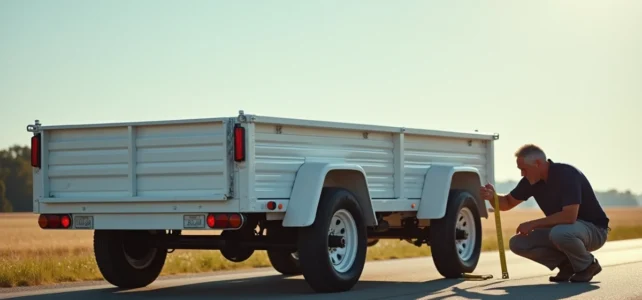
The loadable length of a trailer does not correspond to its total length. This technical measurement, defined by the decree of August 18, 1955, concerning the braking of motor vehicles, is used to calculate the braking performance of towed vehicles. Confusing it with the dimensional limits set by the Highway Code leads to misjudgments when choosing or homologating a trailer.
Loadable length and braking: a technical definition often overlooked
Most online guides address the length of a trailer from the perspective of road dimensions, that is, the total distance from the front of the drawbar to the rear of the chassis. The loadable length is a different parameter, related to braking requirements and not to maximum traffic dimensions.
The decree of August 18, 1955, still in force through its successive amendments, introduces this measurement for all category O trailers and semi-trailers subject to braking obligations. The regulatory formula that follows links the loadable length of a trailer to the weight of the towed vehicle and determines the performance thresholds that the braking system must achieve.
In practice, this length corresponds to the part of the chassis that is actually usable to receive the body or load, excluding the drawbar and any non-structural overhangs. It directly affects the sizing of the brakes, the load distribution on the axles, and technical compliance during inspections or technical checks.

Maximum total length of a trailer according to the Highway Code
Articles R. 312-10 and R. 312-11 of the Highway Code set the dimensional limits for road vehicles operating in France. These dimensions concern the overall length of the combination (towing vehicle + trailer), not just the loadable length.
The maximum limits to consider are as follows:
- A motor vehicle with a trailer (truck + trailer) must not exceed 18.75 meters in total length.
- A tractor with a semi-trailer (articulated combination) is limited to 16.50 meters.
- The maximum width is 2.55 meters (2.60 meters for refrigerated vehicles), and the maximum height is 4 meters.
These maximum lengths can be exceeded by 15 centimeters for containers in intermodal transport. Cabs equipped with aerodynamic devices also benefit from a tolerance, without increasing the authorized payload.
Light trailers: specific rules
For trailers towed by a light vehicle (category B), the total length of the combination must not exceed 18 meters. The trailer itself does not have a separately fixed maximum length in the Code, but it is the entire combination that is measured, from the front of the tractor to the rear of the trailer, including the load.
The overhang of the load at the rear is limited to 3 meters for a vehicle or combination longer than 11 meters. Any rear overhang exceeding 1 meter requires a specific signaling device (sign or lights).
Penalties for exceeding regulatory dimensions
Exceeding dimensional limits on public roads exposes one to a fourth-class fine, which is a fixed penalty of 135 euros. If the excess exceeds the regulatory limits by more than 20%, the penalty escalates to a fifth-class fine, with a higher fine and possible immobilization of the vehicle.
Article R. 412-11-2 of the Highway Code also specifies that aerodynamic devices mounted at the rear must be retracted, folded, or removed if the vehicle is operating outside of highways or regulated access roads. Non-compliance with this obligation falls under the same fourth-class fine.
The immobilization of the vehicle can be ordered by law enforcement, blocking delivery or travel. For road transport professionals, an immobilized vehicle represents a cost far exceeding the amount of the fine.

Weight, axles, and load: parameters related to loadable length
The loadable length directly influences the weight distribution on the axles. A longer body allows for spreading the load, which reduces stress per axle. Conversely, a short loadable length concentrates mass and increases ground pressure.
This distribution affects:
- The maximum allowable weight per axle, which varies according to the number and spacing of the axles.
- The effectiveness of braking, as a front-rear imbalance extends stopping distances.
- The stability in turns and descents, directly dependent on the center of gravity of the load.
For articulated vehicles, the maximum authorized total weight in France is capped at 44 tons under environmental and technical conditions. Compliance with this cap involves a combined calculation of the payload, empty weight, and distribution across each axle, three parameters that the loadable length helps to determine.
Registration and registration certificate
The registration certificate of a trailer mentions its dimensions, its empty weight, and its GVW. Any modification of the loadable length requires a new inspection (passing through the mines) and an update of the registration certificate. Installing a longer body on an existing chassis without declaration renders the vehicle non-compliant.
Distinguishing the loadable length from the total length remains the starting point for any technical verification. The former relates to braking and weight distribution, while the latter pertains to road dimensions. Both are regulated, but by different texts, and a trailer can be compliant on one criterion while exceeding the other.