
A mobile home, in the sense of the Urban Planning Code, is a mobile leisure residence (RML): a habitable vehicle that permanently retains its means of mobility (wheels, chassis, towing bar). As soon as it loses this mobility, whether by being placed on blocks, having the axle removed, or pouring a slab, it falls into the category of constructions. This distinction governs all the legal regime applicable on private land.
Mobility of the mobile home and legal qualification: the criterion that municipalities check first
The Urban Planning Code classifies the mobile home among mobile leisure residences under one condition: that it can be moved at any time by simple towing. Wheels, axles, and the towing bar must remain functional. A mobile home connected to utilities (water, electricity, sanitation) does not automatically lose its mobile status, as long as these connections are removable.
On the other hand, placing it on a permanent foundation, adding a masonry terrace attached to it, or removing the rolling system transforms the mobile home into a construction under Article L. 421-1 of the Urban Planning Code. A building permit is then required, and the land must be buildable.
Before any action, checking the actual condition of the chassis and wheels is the first step. A second-hand mobile home whose axle has been removed by the previous owner is no longer, legally, an RML. To install a mobile home on private land legally, this qualification conditions all the subsequent obligations.
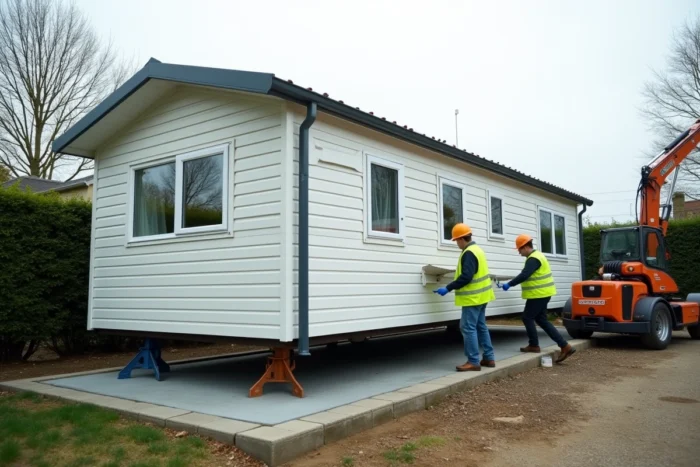
Duration of occupation on private land: the threshold of three months per year
The Urban Planning Code allows the parking of an RML on private land without any formalities, provided that the occupation does not exceed three months per calendar year. During this period, the mobile home can be temporarily connected to utilities, used for sleeping, or hosting visitors.
Beyond three months, the installation becomes permanent and falls under the regime of urban planning authorizations. The municipality may require a prior declaration or a development permit depending on the situation of the land. Failing to respect this threshold exposes one to a report of violation of the Urban Planning Code, with an obligation to restore the land.
Beware of satellite image monitoring
Recent disputes show that urban planning services use satellite photos and connection invoices to prove the age and permanence of an installation. A resident was prosecuted in the correctional court for a mobile home installed without authorization, with the question of prescription being debated based on this visual evidence. The absence of a declaration is not a harmless oversight: municipalities have concrete tools to establish the violation, even years after the installation.
Zoning of the PLU and STECAL zones: where long-term installation is possible
The nature of the land determines what is permitted. Three cases arise:
- On a buildable land (zone U or AU of the PLU), the durable installation of a mobile home is possible, subject to a prior declaration or a development permit depending on the ground area and local regulations.
- On land classified as agricultural (A) or natural (N), the installation of an RML is generally prohibited. However, the ALUR law of 2014 allowed municipalities to create sectors of limited size and capacity, called STECAL, within these zones. These sectors allow the installation of light habitats, including mobile homes, but their creation remains at the discretion of the municipal council.
- In a classified campsite or a residential leisure park (PRL), installation is allowed by default, with a specific placement contract.
Consulting the PLU or the municipal map at the town hall before purchasing the mobile home avoids ending up with a vehicle that cannot be legally placed. Some municipalities even prohibit temporary occupation of three months in protected areas.
Main residence in a mobile home on private land: a highly regulated possibility
The mobile home is classified as a mobile leisure residence, not as housing. Living in it year-round on private land is prohibited unless expressly exempted by the municipality, an exemption described by practitioners as rare and difficult to obtain. In practice, permanent residence is only allowed in a classified campsite or a PRL open twelve months a year, with a lease or placement contract.
This restriction has direct consequences on administrative domiciliation. A mobile home installed on private land outside the authorized framework does not constitute a recognized address for receiving official mail, registration on electoral rolls, or obtaining certain social benefits.

Housing tax and tourist tax
A permanently installed mobile home may be subject to housing tax on second residences as well as to tourist tax if the municipality applies it to leisure accommodations. As long as the mobile home retains its status as an RML, it is exempt from property tax, which only applies to permanent constructions.
Sanctions and disputes in case of non-compliant installation
The installation of a mobile home without complying with urban planning rules constitutes a criminal offense. The municipality can draw up a report and require the restoration of the land, which concretely means the removal of the mobile home. The court may impose a fine and set a deadline for the restoration work, accompanied by a daily penalty in case of delay.
The risk does not disappear over time. The question of prescription remains complex and depends on the date when the violation was observed, not the date of installation. Historical aerial photos, accessible to urban planning services, allow for retroactive documentation of the presence of the mobile home.
The entire regulatory chain, from the status of the RML to the zoning of the PLU through the three-month threshold, forms a coherent whole. Checking each link before signing an order form remains the only reliable way to avoid a dispute that will cost much more than the mobile home itself.