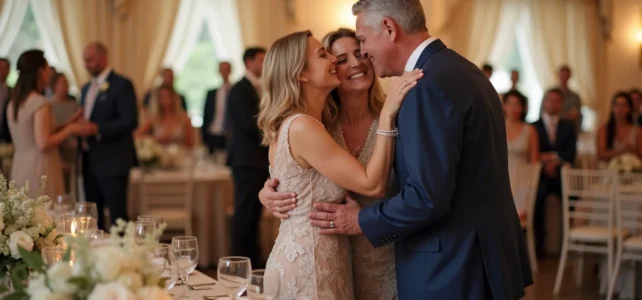
Congratulations addressed to the parents during their daughter’s wedding are a distinct social practice from the message sent to the newlyweds. The recipient changes, as does the tone: we do not celebrate the couple’s love, but the role of those who have accompanied the bride up to this day. Understanding this nuance allows for writing a message that resonates accurately, without falling into generic phrases.
What distinguishes a message to the parents from a message to the newlyweds
A text intended for the newlyweds speaks of the future, of life together, of shared projects. A message to the parents looks back. It acknowledges years of upbringing, presence, and sometimes discreet sacrifices.
The key term here is the recognition of the parental journey. The parents are not getting married; they are passing on. Their daughter symbolically leaves one home to establish another, and it is this transition that the message must acknowledge.
Addressing congratulations to the parents for a wedding therefore requires distinguishing between two axes: the pride they may feel, and the gratitude of those around them towards them. Confusing these two axes with a simple “congratulations and long live the newlyweds” results in a message that addresses no one in particular.
Appropriate tone and register based on the relationship with the parents
The degree of closeness with the bride’s parents determines almost everything: the length of the message, the use of informal or formal address, the level of acceptable emotion.
Close relatives and extended family
An uncle, a cousin, or a long-time friend of the parents can afford a personal touch. Mentioning a specific memory of the bride as a child, recalling a character trait inherited from her parents, or mentioning a shared family moment: these details make the text irreplaceable.
The phrase “You must be so proud” only works if it is followed by a concrete element. Without that, it remains hollow.
Colleagues, neighbors, acquaintances
With less intimacy, the message benefits from remaining understated. Two or three sentences are sufficient. Formal address is necessary, and it’s better to have a short and sincere text than a long paragraph filled with empty phrases.
A good guideline: if the message could apply to any parents in any context, it lacks substance. Even a colleague can slip in a line about the visible joy of the parents during the announcement.
Common pitfalls to avoid in congratulatory messages to parents
Several writing reflexes produce awkward texts without the author realizing it.
- Talking more about the couple than the parents. The message is meant for them, not to serve as a duplicate of the newlyweds’ greeting card.
- Using a series of superlatives (“the most beautiful day,” “the most wonderful daughter,” “the best parents in the world”) that sound like a copy-paste from a pre-printed card.
- Forgetting to mention both parents. If the message is addressed to the parental couple, naming only the mother or only the father creates a noticeable imbalance.
- Projecting one’s own emotions to the point of making the text self-centered. A sentence about how you feel is enough; the rest should concern the parents.
The most frequent trap remains excessive generic sentimentality. A message that accumulates “happiness,” “love,” “joy,” and “emotion” without concrete grounding gets lost in a lexical fog that the parents will read without retaining.
Concrete structure of a successful message
A congratulatory text for the bride’s parents does not need to be long. Its strength lies in its architecture, not its length.
Three elements to include
- An opening that names the event and the recipients: “The wedding of [first name] is a joy that you deserve to fully savor.” This sentence anchors the subject without detours.
- A personal element or a sincere observation: “You can see in her smile everything you have passed on to her,” or “Your emotion during the ceremony spoke more than any speech.”
- A wish directed towards the parents themselves, not just towards the couple. Wishing them to enjoy this new stage, the bond with their son-in-law, the happiness of seeing their daughter thriving.
This three-part structure (recognition, observation, wish) can be expressed in four to six sentences. It adapts well to a handwritten card, a message in the guestbook, or a text sent by mail.
Handwritten or digital: the medium matters
A handwritten message addressed to the parents holds a special value. In a context where most congratulations arrive via messaging, a handwritten card can be kept and reread.
For a digital send-off, brevity is even more important. Three well-chosen sentences on a screen have more impact than a long paragraph that no one will read to the end.
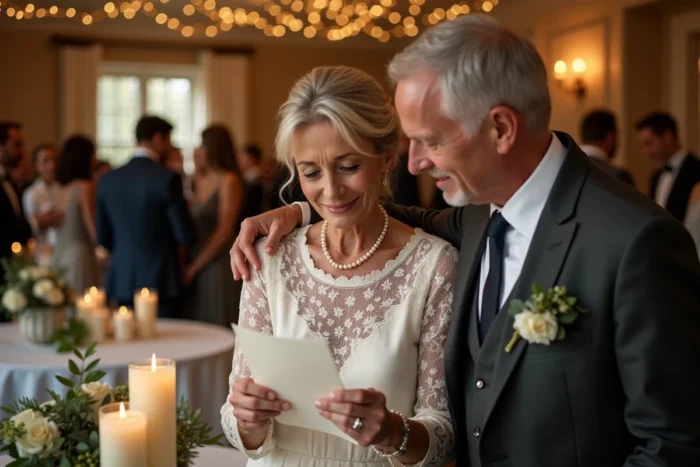
Timing of the message: before, during, or after the ceremony
The timing of the message influences its reception. Before the wedding, a note to the parents expresses anticipation and shared joy. On the day itself, a note in the guestbook or a few words slipped in during the reception create a memory anchored in the moment.
After the ceremony, a letter sent in the following days has a different effect. Parents reread these words once the excitement has settled, in a calmer moment. A message received after the wedding often resonates more because it arrives when the attention of loved ones has already dispersed.
Whatever the chosen moment, the rule remains the same: speak about the parents, what they represent on this day, and the pride they carry. The couple has their own congratulations. The parents deserve theirs.