Slow travel is a planning method that restructures the relationship with time, space, and accumulated fatigue. Rediscovering the pleasure of traveling slowly requires rethinking the duration of stays, modes of transport, and the granularity of the itinerary, with a measurable goal: to return less tired than when departing.
Stay duration and number of places: the calculation that travelers overlook
The most underestimated variable in planning a slow trip is the ratio between the number of nights and the number of places visited. A ten-night stay spread over five cities generates as much logistical fatigue as a traditional organized tour: check-in, check-out, transfers, neighborhood scouting, searching for restaurants.
A functional ratio for slow travel is around three to four nights per place. Below two nights, the benefit of immersion disappears. The traveler spends their cognitive energy orienting themselves rather than observing.
This calculation also changes the nature of the accommodations chosen. With four nights in the same place, renting an apartment or booking a guest room with a kitchen becomes cost-effective and eliminates the constraint of dining out for every meal. Reducing the number of places frees up useful time for walking exploration, reading on-site, and unplanned conversations with locals.
Itineraries built around this principle already exist for certain regions in France. In Provence, for example, the Provence Unpacked website offers routes designed for staying within a limited perimeter rather than traversing the region by car.

Slow transport and well-being: what recent data shows
Trains or bicycles are often presented as eco-friendly choices, but the primary motivation for travelers adopting these modes of transport is more about comfort and health. According to the European Travel Trend Report 2026 from the DERTOUR group, recovery and stress reduction top the expectations associated with slow travel. Emission reduction is not their main motivation.
Train travel is also gaining popularity for reasons of comfort and flexibility, not just to reduce carbon footprints. The ability to get up, walk in the carriage, read, or work during the journey transforms travel time into rest time. A short-haul flight, with check-in, waiting, and baggage claim phases, often takes as much time as a four to five-hour train journey, without offering any of these comfort margins.
European regulatory framework and multimodal itineraries
The European transport policy encourages strengthening continuity between rail, air, and maritime networks across the continent. For the slow traveler, this evolution ultimately means integrated cross-border transport corridors, with combined ticketing and better-coordinated connections.
In France, the Climate and Resilience Law already prohibits domestic air links when a rail alternative of less than two hours and thirty minutes exists. This regulatory constraint has mechanically redirected some traffic towards rail on routes like Paris-Lyon or Paris-Bordeaux, creating a ripple effect for other journeys.
Slow travel in daily life: transposing the slow pace outside of vacations
The benefits of slow travel evaporate within a few days if the return to daily life immediately reproduces conditions of cognitive overload. We observe that regular practitioners of slow travel apply some of its principles in their everyday lives, without necessarily going on a trip.
The transposition relies on three concrete mechanisms:
- Reducing the number of daily trips by grouping activities by geographical area, as one does in a slow travel stay where one remains within a defined perimeter.
- Replacing a car trip with a walk or bike ride when the distance allows, not out of ecological virtue, but to regain a transition time between two activities, a buffer that does not exist in a car-parking-office sequence.
- Planning time slots without assigned objectives, following the model of free afternoons during an unprogrammed stay, where wandering often leads to the best discoveries.

This method transfer is not trivial. It changes the perception of available time. A weekend spent in one’s own city with a low activity ratio (two planned things, the rest open) resembles a slow stay more than a three-day weekend overloaded with social obligations.
Destinations and duration: how to choose a place suitable for slow travel
Not all territories lend themselves to slow travel with the same ease. The selection criteria differ from those of a classic trip.
Density of points of interest per square kilometer
A place suitable for slow travel has a sufficient concentration of things to see, eat, and explore within a walkable or bikeable radius. Large metropolises offer this density, but with a level of sensory stimulation (noise, crowds, urban pace) that contradicts the goal of rejuvenation.
Rural areas with a network of closely spaced villages, regular markets, and marked trails work better. Provence, Tuscany, the Basque Country, or the Peloponnese share this characteristic: one can spend an entire week within a limited radius without exhausting the possibilities.
Rail accessibility from home
A slow stay that begins with a long-haul flight with a layover poses a coherence problem. The stress accumulated during transport cancels out some of the expected benefits. Favoring destinations accessible by train from home reduces this friction. For travelers based in France, this naturally directs them towards southern France, northern Spain, Switzerland, northern Italy, or Belgium.
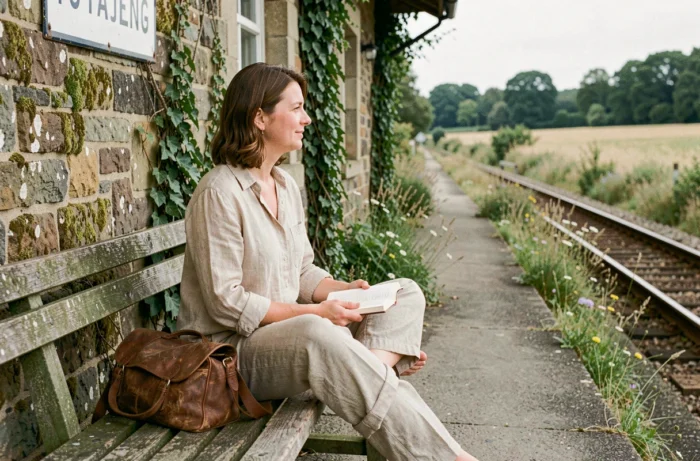
The duration of the journey itself is part of the stay. A Paris-Marseille trip by TGV, with a book and a notebook, already marks a break in rhythm compared to daily life. Slow travel begins at the station, not upon arrival.
Long stays and budget: the financial equation of slow travel
Staying longer in the same place changes the structure of expenses. The categories that decrease include:
- Inter-city transport, which disappears or is reduced to a few local bus or regional train trips.
- Dining, if the accommodation allows for cooking. Shopping at the local market costs significantly less than eating at a restaurant twice a day.
- Paid activities. A traveler with time does not need to compensate with organized excursions. Walking, biking, and reading on a terrace cost nothing.
The categories that increase are accommodation (more nights) and possibly bike rental for several days. The overall balance often remains neutral or even positive compared to a short stay with air transport and a hotel in the city center.
Slow travel also reconfigures the frequency of departures. Two long stays per year replace four short getaways, with a higher level of rejuvenation and a reduced carbon footprint due to structural effects. When the rhythm of the stay resembles the pace one desires for daily life, the return home no longer triggers that feeling of a harsh descent that traditional vacations maintain.