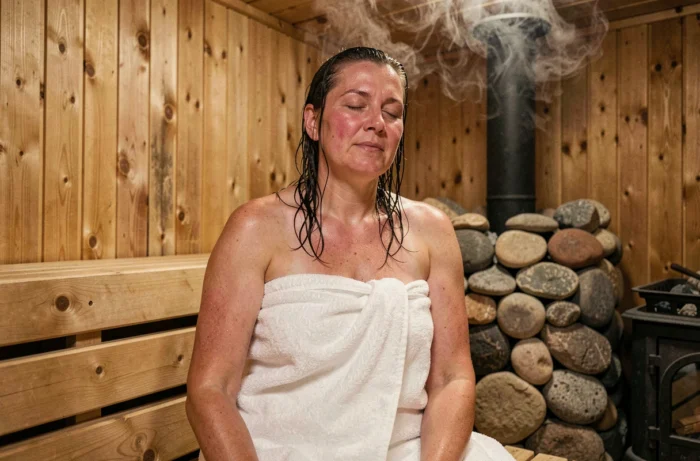
The dry heat of a cabin between 70 and 100 °C triggers a cascade of physiological responses that go beyond mere relaxation. Understanding these mechanisms allows for better calibration of the frequency and duration of sessions, and helps avoid marketing shortcuts that confuse statistical association with proven causality.
Cardiovascular response to the sauna: what the data really says
Exposure to dry heat leads to rapid peripheral vasodilation, an increased heart rate, and a transient drop in blood pressure. The body reacts as it would during moderate physical exertion. This analogy has fueled the hypothesis of a protective effect on the cardiovascular system.
Large Finnish cohorts have indeed observed an association between high sauna frequency and a reduction in certain cardiac events. The systematic review and meta-analysis by Hamaya et al., published in the American Journal of Preventive Cardiology in 2025, nuances this finding: the data do not prove that sauna prevents cardiovascular diseases. These are observed associations, not established cause-and-effect links.
This distinction is not a rhetorical detail. It changes the way we can present health benefits with Sauna Imelda or any other program incorporating heat baths: the sauna complements an overall lifestyle, it does not replace it.
Benefits of the sauna on muscles and sports recovery
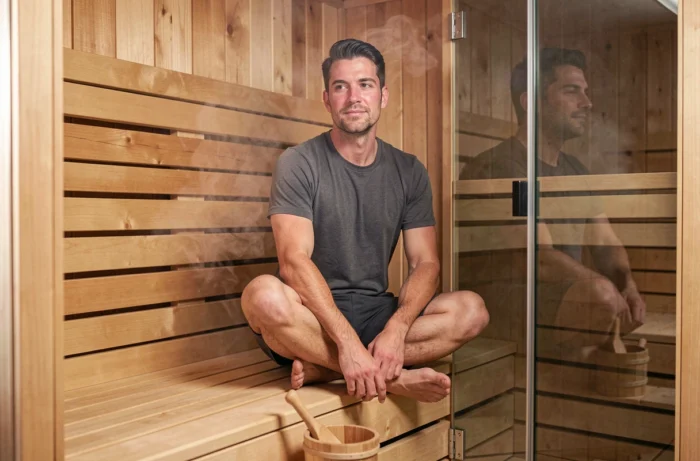
The argument for muscle recovery is probably the most widespread in wellness spaces. Heat does indeed relax muscle fibers, relieve cramps, and reduce post-exercise soreness. This immediate feeling is real and reproducible.
Scientific evidence on sports recovery per se remains weaker. Ahokas et al. (Sports Medicine – Open, 2025) note that the studies examined several types of heat, not just traditional sauna. The protocols varied too much to conclude on the specific effectiveness of a Finnish cabin in reducing fatigue markers.
For a regular athlete, the sauna after training has a clear interest in muscle comfort and the feeling of relaxation. Claiming that it accelerates cellular recovery exceeds what the literature currently supports.
Effects of the sauna on the skin and detoxification
Abundant sweating opens pores, removes superficial impurities, and gives the skin a smoother appearance after the session. The traditional sauna is often cited as a complement in managing psoriasis or eczema, although the data remains observational.
The term “detoxification” deserves reframing. Sweating mainly expels water and minerals, not toxins in the metabolic sense of the term. The liver and kidneys handle most of the filtration. The massive sweating experienced in the cabin produces skin cleansing, not a purge of the body.
This clarification matters, as it conditions a practical point often overlooked:
- Rehydration after each session is non-negotiable. Water loss can be significant within minutes at high temperatures.
- Sensitive or reactive skin may worsen an inflammatory flare-up if the session is too long or too hot.
- The hot-cold alternation (cold shower after the cabin) stimulates skin microcirculation and enhances local vascular tone.
Sauna and mental health: stress, sleep, mood
The anxiolytic effect of the sauna is one of the most reproducible benefits. Heat stimulates the release of endorphins, induces deep muscle relaxation, and lowers circulating cortisol levels. The feeling of calm that follows a session is not placebo: it corresponds to a measurable change in hormonal state.
The impact on sleep logically follows. Post-session thermoregulation, with a gradual cooling of the body, facilitates falling asleep. Several practitioners incorporate the sauna at the end of the day into protocols for managing chronic stress.
Passive heat improves mood temporarily, but equating it to an antidepressant treatment remains premature in the absence of large-scale clinical trials on this specific point.

Finnish sauna or infrared cabin: a distinction not to be overlooked
Most studies cited in the press focus on traditional Finnish sauna, with a resistance stove, heated stones, and a high cabin temperature. Infrared cabins, which operate at lower temperatures and have a different heating mechanism, constitute a distinct physiological exposure.
Laukkanen et al. (Mayo Clinic Proceedings, 2018) highlight this limitation: transposing the results of the Finnish sauna to infrared cabins is unfounded. Infrared cabins have their own data, often derived from clinical contexts (heart failure, chronic pain), with specific protocols.
Three points to remember before choosing:
- The Finnish sauna is suitable for those who tolerate high temperatures and seek complete hot-cold alternation.
- The infrared cabin exposes to milder heat, better tolerated by certain profiles (elderly people, chronic conditions), but its effects do not overlap with those of the traditional sauna.
- Neither type exempts one from medical advice in case of heart issues, pregnancy, or medication affecting thermoregulation.
As for the weight loss often highlighted, it primarily corresponds to water loss. The weight lost on the scale after a session returns with rehydration. The sauna is not a weight loss tool.
The sauna remains a solid ally for stress management, muscle comfort, and skin quality, provided that we do not attribute virtues that current data do not confirm. Calibrating expectations based on what science observes, without extrapolating, allows for fully enjoying each session.