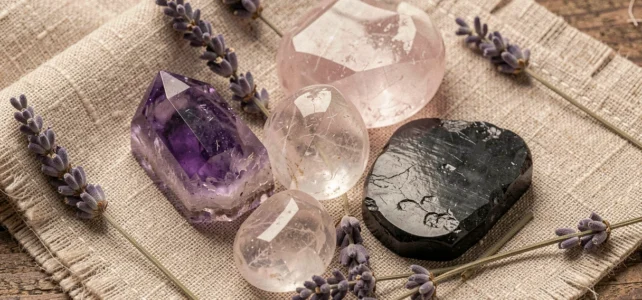
Lithotherapy is based on the idea that certain minerals emit vibrations capable of interacting with emotional states. This wellness practice, not recognized by conventional medicine, lacks scientific evidence validated by reproducible clinical studies. The properties attributed to stones are based on beliefs and traditions passed down for centuries. Nevertheless, many people incorporate these minerals into their daily lives as a complement to their stress and anxiety management.
Mineral composition and color: what distinguishes one soothing stone from another
Not all stones associated with anxiety share the same crystalline structure. Amethyst, a variety of quartz colored by traces of iron and natural irradiation, has a characteristic purple hue. Rose quartz gets its color from the presence of titanium, manganese, or microscopic fibrous inclusions. These differences in composition explain why lithotherapy assigns distinct properties to each stone.
Color plays a central role in the choice of a stone. Traditions associate purple and blue tones with mental calmness, while pinks are linked to emotional soothing. Dark stones like black tourmaline or smoky quartz are more related to grounding and protection against intrusive thoughts.
A mineral like lapis lazuli combines several components (lazurite, calcite, pyrite), giving it visual complexity and, according to practitioners, an effect on self-confidence. Amazonite, recognizable by its blue-green color, is a variety of microcline feldspar whose hue comes from traces of lead.
In lithotherapy, amazonite is reputed to help filter sources of worry. Several detailed references are compiled on the list pierre natacha-birds.fr on Blog Too, which lists stones commonly associated with anxiety management.
Amethyst, rose quartz, and smoky quartz: three stones for three forms of anxiety
Anxiety does not manifest the same way in everyone. Mental ruminations, bodily tensions, social fears: each expression can point to a different mineral.
Amethyst and mental rumination
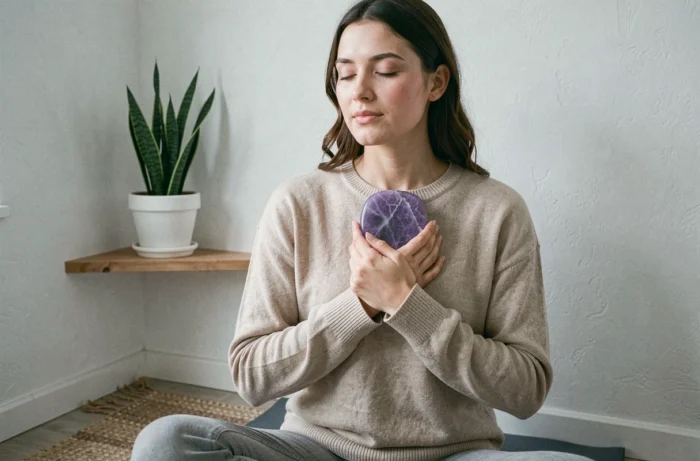
Amethyst is the most frequently cited stone for calming racing thoughts. Practitioners recommend placing it on a bedside table to promote falling asleep, or wearing it as jewelry during the day. Its association with serenity makes it a logical starting point for those discovering lithotherapy.
Rose quartz and emotional tensions
Rose quartz is traditionally linked to soothing deep fears and phobias. According to lithotherapy practices, it would act on stress at a deep level, especially when anxiety manifests as sleep disturbances or relational tensions. Worn close to the heart (as a pendant), it is said to assist in releasing accumulated emotions.
Smoky quartz and physical grounding
When anxiety causes a feeling of disconnection or floating, smoky quartz is often recommended. Its brown to gray hue, obtained through natural irradiation of quartz, symbolically ties it to the earth. It is said to promote a return to bodily grounding for those prone to diffuse anxiety or panic attacks.
Wearing, placing, or meditating: ways to use stones in daily life
The choice of support conditions how the stone accompanies the day. An amethyst or amazonite bracelet remains in contact with the skin, which practitioners consider the most direct mode of interaction. Natural stone jewelry (bracelets, necklaces, rings) is the most common format.
Placing a raw or polished stone on a desk, in a bag, or under a pillow constitutes another approach. Some people associate the manipulation of a howlite or blue chalcedony pebble with a centering gesture, similar to squeezing a stress ball.
- As a bracelet or necklace for prolonged skin contact throughout the day
- As a pocket stone (polished pebble) to touch during moments of tension
- As a geode or raw stone placed in the bedroom to accompany sleep
- As a meditation aid, held in the palm during a few minutes of conscious breathing
Regularity matters more than quantity. One mineral worn every day will be more coherent, according to practitioners, than an entire collection used in a scattered manner.
Care for stones and limits of lithotherapy
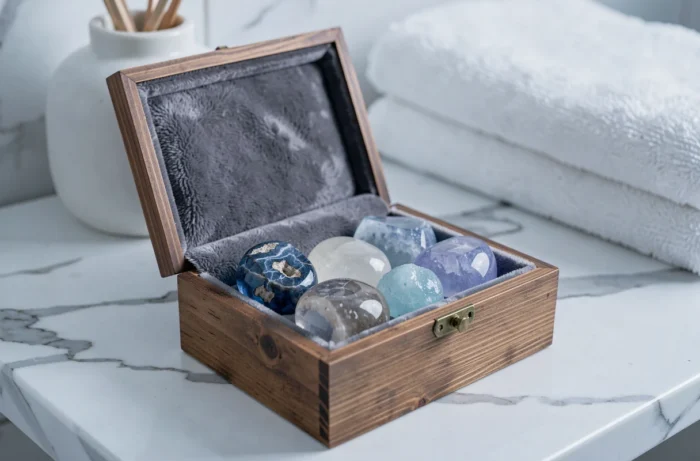
The minerals used in lithotherapy require regular maintenance to retain their appearance. A rinse with clear water is sufficient for most quartz, but some stones like lapis lazuli or selenite are sensitive to prolonged moisture. Recharge is traditionally done under moonlight for stones associated with gentleness (rose quartz, amethyst), or under moderate sunlight for those linked to energy (tiger’s eye).
Lithotherapy does not replace medical treatment or psychological follow-up. Several specialized shops have indeed strengthened their warnings in recent years, specifying that this practice has no role in emergency situations and does not constitute treatment for mental or psychiatric disorders. This transparency is a sign of maturity in the sector.
The use of natural stones to soothe anxiety is part of a personal wellness approach. It can be integrated into a broader lifestyle that includes physical activity, breathing, and appropriate follow-up. The mineral accompanies, it does not heal – a distinction that every user should keep in mind when choosing their first stone.