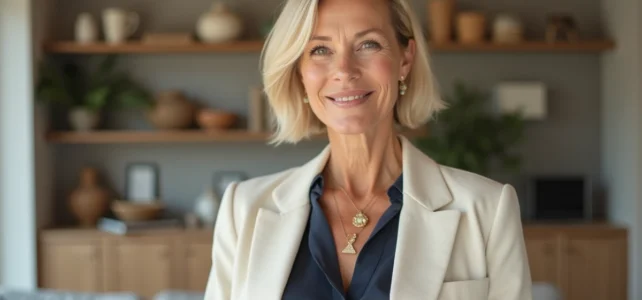
Sylvie Adigard is one of those faces that early risers instantly recognize. A lifestyle columnist on the show Télématin on France 2, she discusses design, architecture, and crafts with an energy that stands out at that hour. Her professional life is well-documented: production company, documentary film projects, an apartment in the 9th arrondissement of Paris open to photographers. Her private life, however, remains a territory that search engines struggle to map.
Sylvie Adigard’s Private Life: What Public Sources Do Not Confirm
The question regularly appears in search bars: who does Sylvie Adigard live with? Celebrity sites compile paragraphs around this inquiry, but no primary source (direct interview, public statement, post on her social media) provides a verifiable answer.
The content available online all highlights the same observation: Sylvie Adigard does not reveal any marital or family details in her media appearances. Neither on the set of Télématin nor in portraits published by decor or lifestyle press. An article dedicated to her Parisian apartment, published by Côté Maison, details her lighting fixtures, her repurposed Ikea furniture, her desk cluttered with press materials, but mentions no partner.
For those looking to know more, a detailed article attempts to answer the question of who is Sylvie Adigard’s husband by cross-referencing accessible information.
Television Personality and Discretion: The Mechanics of a Preserved Private Life
The case of Sylvie Adigard illustrates a broader phenomenon. Some personalities in French television build their notoriety on an area of expertise (weather, cooking, decor) without ever opening the door to their romantic life. The strategy works as long as the person controls their statements.
Preserving one’s private life when appearing weekly on a national channel involves several deliberate choices:
- Never mentioning a first name, marital status, or family situation during interviews, even when the question is directly posed by the journalist
- Maintaining social media focused exclusively on professional content (reports, design events, behind-the-scenes of filming)
- Refusing television formats like intimate portraits, confessions, or “at home” segments that mix personal life and promotion
Sylvie Adigard has agreed to open her Parisian apartment to The Socialite Family and Côté Maison, but these visits remain strictly focused on decoration. No family photo frames, no marital anecdotes filter through in these reports. The monstera deliciosa that stands in her living room serves as the only “companion” mentioned by journalists.
When the Algorithm Creates the Question About Sylvie Adigard’s Husband
The search “Sylvie Adigard husband” or “Sylvie Adigard partner” generates enough volume for Google to automatically suggest it. This mechanism creates a circle: the more the question is typed, the more it rises in results, the more editorial sites publish an article to answer it, even when the answer does not exist.
The topic is fueled by the algorithm and the lack of primary sources, not by a media revelation. The pages that appear at the top all reformulate the same absence of information. No verifiable source settles the question, and this blank area paradoxically feeds the visibility of the query.
This phenomenon does not only concern Sylvie Adigard. Any regular columnist on a morning show aired on France 2 sees their name associated with queries about their age, salary, or partner. The morning show creates a form of familiarity with the public that drives the search for personal information, as one would for a neighbor encountered every morning.
Sylvie Adigard Beyond Télématin: Career and Documentary Projects
Reducing Sylvie Adigard to the question of her romantic life obscures a dense professional background. Born in Casablanca, she has built her career around lifestyle and design. Her columns in Télématin represent only a part of her activity.
She runs her own production company, through which she develops projects that go beyond the short format of the morning show. Among the projects mentioned in the press: a documentary film dedicated to designer Philippe Starck, a series of podcasts on the beginnings of figures in the decoration world, and a project aimed at the younger generation whose contours remain unclear.
Her Haussmannian apartment in the 9th arrondissement of Paris serves as both a living space and an office. She works there every evening after her reporting days, surrounded by design books, filming mementos, and what she calls her “little trinkets.” Her interior mixes design pieces and Ikea furniture, vintage finds, and discoveries from emerging creators, rejecting what she calls a “total look.”
A Columnist Who Prefers to Talk About Others
In her interviews available online, Sylvie Adigard systematically redirects the conversation towards the creators she meets, the trends she observes, the artisans she films. This professional stance, focused on transmission rather than confession, partly explains why personal information remains so rare.
The portrait published by The Socialite Family describes her as “passionate, carried away by a job that is never boring where each day means new encounters.” The phrase resembles a cliché, but it reflects a real positioning: Sylvie Adigard builds her visibility on her expertise, not on her private life.
The question of who shares her life will likely remain publicly unanswered as long as she maintains this stance. Search engines will continue to suggest the query, sites will keep publishing articles to answer it, and verifiable information will remain at a standstill.