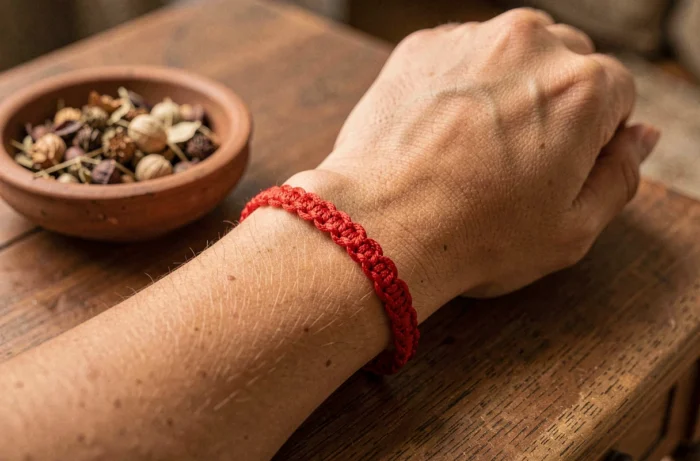
The red thread bracelet with seven knots operates on a principle of intentional fixation through knotting: each knot seals an intention within the fiber, the red thread serving as a symbolic conductor. We observe an increasing confusion between the documented symbolism of the number seven and the attribution grids by knot, largely constructed by the contemporary esoteric market. Distinguishing these two registers conditions the understanding of the ritual.
Knot Attribution Grids: Marketing Construction or Established Tradition
The tables circulating online (knot 1 = protection, knot 2 = love, knot 3 = health, etc.) do not refer to any identified religious text. These detailed distributions appeared in the 2000s-2010s, promoted by spiritual shops and the Kabbalah Centre.
What is documented, on the other hand, is the symbolism of the number seven in Kabbalah: seven days of Creation, seven lower sefirot of the Tree of Life. The number seven carries its own symbolic weight, independent of any knot-by-knot assignment.
We recommend treating each knot as the support of a personal intention formulated at the moment of knotting, rather than following a fixed grid. The ritual effectiveness relies on the precision of the intention articulated aloud, not on a standardized catalog. To delve deeper into the meaning of the red 7 knots bracelet, the purification and activation protocol is as important as the choice of intentions.
Classical Kabbalah and Spiritual Fashion: A Clear Break Since the 2000s
Reference rabbinic sources emphasize that there is no solid halakhic prescription for the red bracelet as a protective amulet. Classical Jewish tradition mentions the red thread in specific contexts (the scarlet thread of the Temple, the red heifer), without making it an apotropaic object to be worn on the wrist.
The global popularization of the red bracelet is directly linked to the Kabbalah Centre and its adoption by celebrities in the 2000s. This movement created a hybrid object, halfway between an identity accessory and a talisman, whose meaning varies according to the wearer.
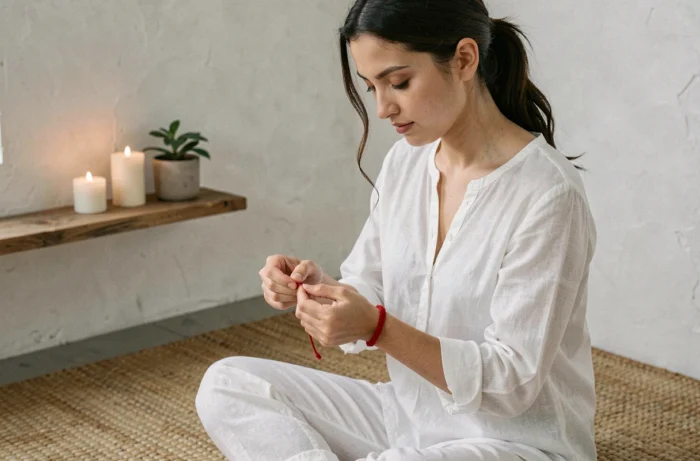
This break between tradition and fashion does not invalidate the practice. It imposes an understanding that the ritual of the seven knots as it is practiced is a matter of modern esoteric reinterpretation, not of an uninterrupted liturgical transmission.
Knotting Ritual of the Red Bracelet: Technical Gesture and Breathing
Knotting is not just about making seven knots on a thread. Each step has a function in the activation protocol.
Prior Purification of the Thread
Fumigation with white sage or palo santo remains the most suitable method for the textile. Immersion in saltwater, often recommended for stones or metals, weakens the fibers, alters the hold of the knots, and can discolor the red thread. We do not recommend this method for a cotton or silk bracelet.
Knotting Sequence and Intention Formulation
Each knot is tied while exhaling slowly. The corresponding intention is formulated aloud or internally at the moment the knot is tightened. Three rules condition the quality of the ritual:
- Formulate distinct intentions from one another, not variations of the same wish. “Protect my health” and “ward off illness” are redundant.
- Use short affirmative phrases in the present tense. “I am protected” rather than “I wish I were no longer afraid.”
- Knot the bracelet yourself or have it knotted by a trusted person, never by a stranger. The emotional bond between the knower and the wearer is part of the ritual in the Kabbalistic tradition.
The left wrist is the one prescribed by Kabbalah, considered the receptive side of the body through which energy enters. Other traditions (Hinduism, Buddhism) do not impose this laterality.
Red Bracelet Combined with Lithotherapy: Compatibilities and Recharge
The hybridization between the red thread and natural stone beads has become widespread. This type of combined bracelet raises a practical question: the recharge protocols differ according to the materials.
The red thread supports fumigation but not prolonged soaking. Stones like tiger’s eye or black tourmaline accept clear water but not all direct sunlight. For a mixed bracelet, fumigation remains the safest common denominator.
- Recharge the stones in moonlight (compatible with the thread) rather than in direct sunlight (risk of discoloration of the red).
- Avoid direct contact with salt on porous beads (lapis lazuli, turquoise) and on the textile thread.
- Space recharges one to two weeks apart for daily use, more if the bracelet is worn occasionally.
Broken Red Bracelet: Interpretation and Replacement
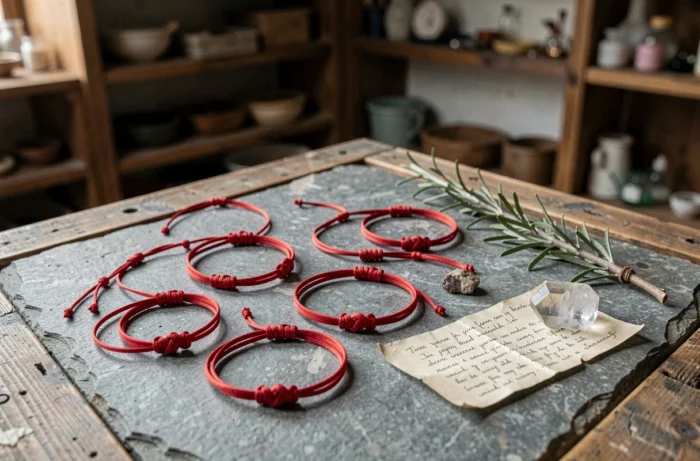
In the ritual reading, a broken bracelet has fulfilled its protective function: it would have absorbed the negative energy it was meant to deflect. This interpretation, although not canonical, is shared by most contemporary practitioners.
On a material level, a cotton or silk thread worn daily undergoes friction, moisture, and mechanical tension. The breakage is also a normal physical phenomenon. An worn bracelet that does not break is not more effective than a new bracelet that is properly activated.
We recommend not re-knotting a broken thread. The protocol consists of thanking the bracelet (some burn it, others bury it), then activating a new one with updated intentions. Intentions evolve, and so does the bracelet.
The red thread with seven knots remains an object whose significance entirely depends on the rigor of the initial ritual and the clarity of the intentions set. Wearing a red bracelet without having activated it amounts to wearing a textile accessory, not a talisman.