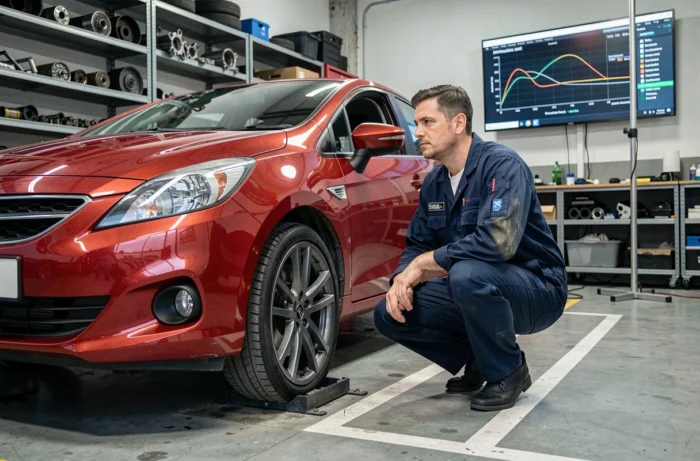
The power bench test remains an unknown service to the general public. Often associated with tuners and engine reprogramming enthusiasts, it actually concerns any owner wishing to know the real performance of their vehicle. Prices vary depending on the providers and packages, and the measurement itself has subtleties that deserve to be clearly stated.
What a rolling road really measures (and what it does not measure)
A power bench does not directly measure engine power. The device records the effort transmitted to the wheels, then estimates engine power by integrating losses related to the transmission (gearbox, differential, drive shafts). The displayed value depends on the protocol used, the type of bench, and the atmospheric correction method applied.
This point is rarely highlighted by the centers offering the service. Two runs performed on different benches, or under different temperature and pressure conditions, can yield significantly different results for the same vehicle. The smoothing of curves and correction factors vary from one software to another.
For a comparison to make sense (for example, before and after a reprogramming), the same conditions must be reproduced: same bench, same engine temperature, same fuel. Serious professionals recommend prior thermal stabilization and several reference runs. Without these precautions, the measured difference may reflect the test conditions more than the modifications made.
Before committing, it may be useful to explore the car bench test from a pricing perspective to better compare the available offers.
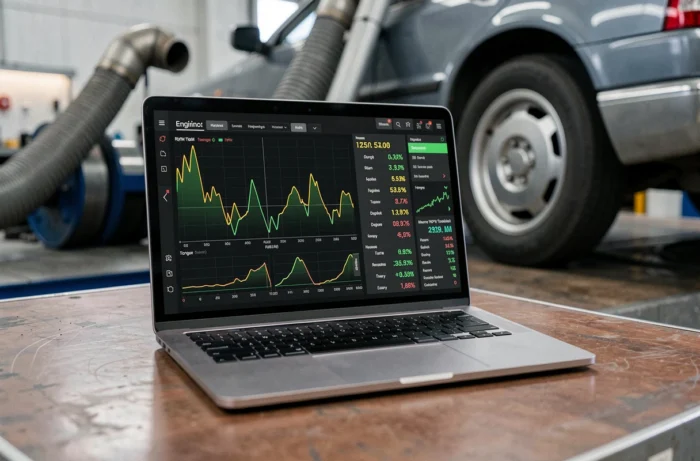
Price of a bench test: observed price ranges
Prices in France depend on the type of service and the chosen center. A simple run on a rolling bench for a car starts from 69 euros including tax at some specialized providers. This price generally corresponds to a standard measurement with the return of power and torque curves.
Group packages exist for sessions organized among enthusiasts or car clubs. Prices then drop significantly per vehicle:
- Session of five vehicles: about 59 euros per car
- Session of ten vehicles: about 49 euros per car
- For motorcycles, prices start lower, from 49 euros individually and 29 euros per motorcycle in a session of ten
These prices only cover the measurement itself. An in-depth diagnosis or a custom reprogramming represents an additional cost, often billed separately. Some centers include the bench test in the price of a stage 1 reprogramming, while others charge it separately.
Bench test and diagnosis: an underutilized tool
Most drivers associate the power bench with pure performance. However, its diagnostic use remains one of the most relevant. Analyzing the torque curve across the entire RPM range allows for the detection of anomalies that a simple road test does not reveal.
Detecting a loss of performance
A worn turbo, clogged injectors, or a partially obstructed intake manifest as a characteristic dip on the curve. The bench objectively confirms a sensation of power loss that the driver perceives without being able to quantify it. This information helps the mechanic direct their diagnosis toward the faulty component, rather than proceeding by elimination.
Validating the condition of a used vehicle
Before purchasing a sports vehicle or a high-mileage car, a bench test provides a snapshot of the actual performance. The gap between the power measured at the wheels and the values originally announced by the manufacturer informs about the general mechanical condition.
Field feedback varies on the relevance of this approach for non-sport vehicles. On a mass-produced diesel with over 150,000 kilometers, a slight drop in power is physiological and does not necessarily indicate a serious problem. The bench becomes particularly useful when a marked discrepancy suggests a specific malfunction.

Engine reprogramming and bench test: framework and limits
The main reason for a bench test remains the validation of an engine reprogramming. The before/after measurement allows quantifying real gains and checking that the modified mapping does not impose excessive strain on the mechanics.
The question of legality deserves to be raised. In France, any modification of engine power must, in principle, be declared and may require an update of the registration document. Driving with an undeclared modified mapping exposes one to complications in case of inspection or accident. The insurer may invoke an unreported increase in risk to refuse coverage.
The bench test itself is not illegal. However, it does not constitute an official document acceptable by the administration. The power curves produced by a private center have no regulatory value: they serve as a working tool for the tuner and information for the client.
Choosing a center for a reliable bench test
Not all power benches are equal, and the operator’s skill is as important as the quality of the equipment. Several criteria allow distinguishing a rigorous provider:
- The type of bench used (two-wheel drive or four-wheel drive) must match the vehicle’s transmission
- The thermal stabilization protocol and the number of runs included in the price
- The return of curves with measurement conditions (temperature, pressure, applied correction)
- The possibility of comparing results on the same bench at different dates
A center that does not communicate its atmospheric correction method or that only performs a single run does not provide a usable measurement. The reproducibility of conditions is the determining criterion for drawing reliable conclusions from a bench test.
Price should not be the only decision factor. A cheaper run conducted under approximate conditions produces a figure, not information. For a diagnosis or validation of reprogramming, the rigor of the protocol takes precedence over the displayed price.