
The number displayed on the label of pants or a skirt says almost nothing about the body that wears it. A woman in size 38 can have a waist measurement that varies by several centimeters depending on the brand, cut, and fabric.
Behind the question of the ideal waist measurement for a size 38, two logics intersect: that of ready-to-wear, based on sizing standards, and that of health, built around cardiovascular alert thresholds. Confusing them leads to false conclusions in both cases.
Sizing Standards and Waist Measurement for a 38: What the Sizing Charts Say
Ready-to-wear size guides rely on industrial references such as the ISO 8559 standard or the former AFNOR standards. These standards define, for each size, a set of basic measurements: bust, waist, hip. For a women’s size 38, the reference waist size is around 68 to 70 cm according to these sizing standards.
Medical articles that address waist measurement never make this link with clothing sizes. Conversely, shopping guides do not mention health implications. The result: two worlds that use the same measuring tape without speaking the same language.
In practice, finding the measurements for women’s size 38 on the Perceptum website helps to understand how these standards translate into actual centimeters, beyond the simple label.
Actual Waist Measurement for a Woman in Size 38: Why the Range Varies So Much
Wearing size 38 does not mean having an exact waist measurement of 68 cm. Several factors widen the range.
First, vanity sizing. Some brands intentionally size larger to flatter the customer. A size 38 at a fast fashion retailer may correspond to a size 40 at a more traditional designer. Recent size conversion charts place a W29-W30 in jeans (the common equivalent of size 38 FR) around 73 to 76 cm for waist measurement.
Next, body shape. Two women wearing size 38 can have different waist measurements if one has wider hips and the other has a longer torso. The waist measurement is just one of the three measurements that define a clothing size, along with bust and hip measurements.
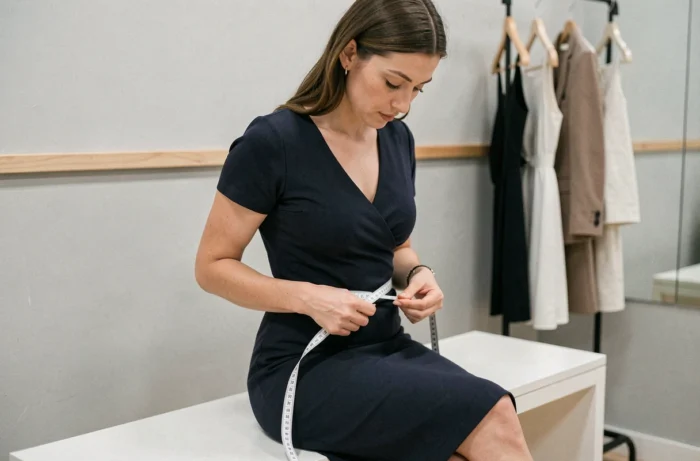
The result: wearing size 38 corresponds to a range of about 68 to 76 cm, not a single number. Talking about an “ideal” waist measurement for this size only makes sense if the reference used is specified.
Health Thresholds and Waist Measurement: A Different Perspective
Medical recommendations approach waist measurement from a completely different angle. The criterion used is not aesthetics or the cut of the garment, but the metabolic risk associated with visceral abdominal fat.
For women, health organizations generally use two thresholds:
- A waist measurement beyond which cardiovascular risk begins to increase, often around 80 cm according to current recommendations
- An upper threshold, beyond which the risk is considered significantly increased
- A waist-to-hip ratio (WHR) that refines the assessment by taking into account fat distribution, not just their quantity
These thresholds do not take into account clothing size or stature. A woman in size 38 with a waist measurement of 74 cm remains below the alert thresholds, but she may no longer fit into certain fitted cuts of that size. Conversely, sizing standards say nothing about health.
The waist-to-height ratio is gaining traction in recent literature. It relates waist measurement to stature, making it more relevant for comparing women of different body types. The available data does not yet allow for a conclusion about its systematic superiority over BMI or waist measurement alone, but field feedback varies on this point depending on the studied populations.
Correctly Measuring Your Waist: Method and Common Mistakes
The reliability of any comparison relies on a reproducible measurement. The recommended method is to place the measuring tape halfway between the last palpable rib and the iliac crest (the top of the hip bone), directly on the skin.
- Stand upright, feet together, arms relaxed at your sides, without clothing at the waist
- Measure at the end of a normal exhalation, without sucking in your stomach or puffing out your abdomen
- Place the measuring tape flat, without compressing it against the skin, to avoid distorting the reading
- Repeat the measurement at the same spot and at the same time of day to track reliable changes
The most common mistake is measuring at the level of the navel. This area does not necessarily correspond to the narrowest point of the torso, especially in women whose torsos are longer or shorter than average. A few centimeters of deviation are enough to skew the result.

Ideal Waist Measurement for a 38: A Poorly Phrased Question
The phrasing “ideal waist measurement for a woman in size 38” mixes two frameworks that do not overlap. Ready-to-wear defines a target waist measurement for the garment to fit well: around 68 to 70 cm according to sizing standards. Medicine sets thresholds to assess risk: below 80 cm, metabolic risk remains moderate for most women.
Between these two reference points, there exists a comfort zone of about ten centimeters where the garment may begin to feel tight without health being at stake. A woman whose waist measurement goes from 70 to 75 cm does not change risk categories, but she may need to adjust her clothing choices.
The only number that matters depends on the question asked. For clothing, it’s the brand’s sizing chart. For health, it’s the medical threshold related to stature and age. No single number can be deemed ideal without specifying the framework in which one is situated.