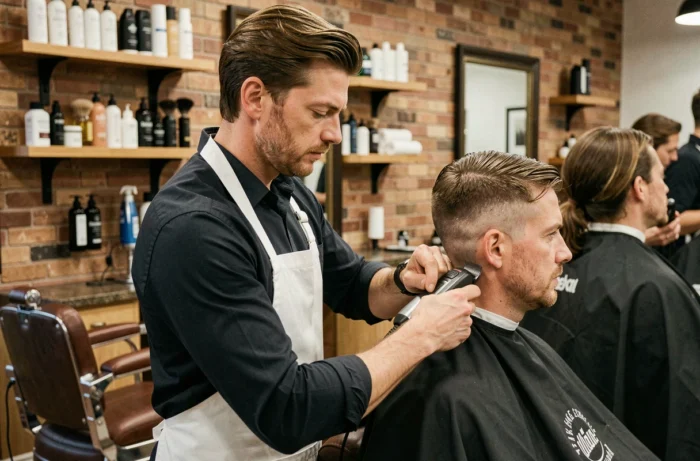
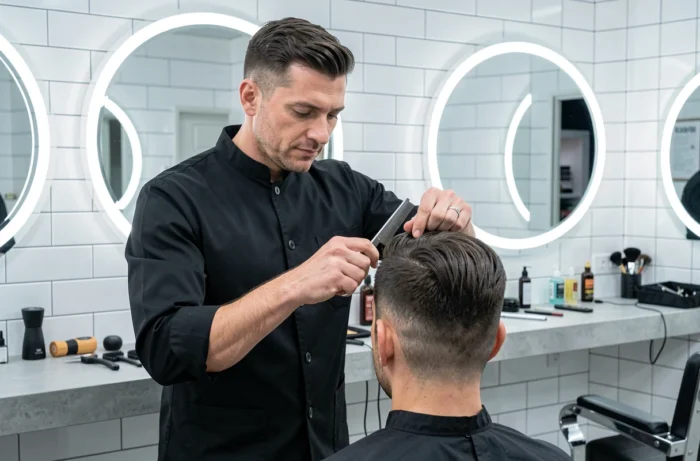
A taper on medium-length hair is based on a simple principle: a gradual fade on the sides and at the nape, without going down to the skin, while leaving enough length on top to allow for movement.
This combination sets a medium-length taper apart from classic short cuts and higher-contrast fades. Choosing this cut raises a question that typical guides rarely address: how to manage regrowth on the sides without sacrificing the length gained every time you visit the barber.
Medium-length taper and the growing-out phase: what changes in your maintenance routine
Most advice on tapers assumes a regular schedule of full touch-ups. With a short cut, trimming the sides every three to four weeks is no problem: the length on top stays the same. But with a medium-length taper that you’re growing out, routinely refreshing the fade maintains a strong contrast between the top and sides, preventing the overall shape from evolving into a longer, more uniform style.
A better approach is to ask for targeted touch-ups around the nape and sideburns, without refreshing the fade on the sides. The sides gradually fill in, and your barber can reshape them once they reach the desired length. This avoids the frustrating cycle of always starting from the same point.
Anyone looking to get a medium-length men’s taper should explain this goal at their first appointment. A barber who understands the end result you’re aiming for can adjust the fade height and the time between touch-ups accordingly.

Taper fade or fade on medium-length hair: a distinction that affects regrowth
People often confuse a taper with a fade, and the difference has a real impact on how the cut looks after a few weeks of regrowth. A taper leaves more length around the edges (temples, ears, and nape). A fade, on the other hand, goes down to the skin or very close to it, creating a sharp contrast with the top.
A classic taper loses its definition more gradually than a fade. On medium-length hair, this becomes an advantage: the cut stays presentable for longer between visits. A skin fade on the sides combined with a top that’s ten centimeters or longer creates a noticeable contrast as early as the second week of regrowth.
So the choice between the two depends on how often you’re willing to visit the barber. For less frequent maintenance, a taper handles regrowth better. For a sharply defined look, a fade is more striking, but it requires more upkeep.
How to explain what you want to your barber
Showing a photo is still the most reliable approach, provided the photo shows a hair texture similar to your own. Specifying where the fade should start (low, mid, or high at the temple) and how far down it should go helps your barber get the shape right.
It’s worth clearly communicating two things:
- The desired length on top, in centimeters or relative to a reference point (mid-ear, eyebrows, chin).
- The desired level of contrast between the top and sides: a soft transition or a visible line.
- Your medium-term goal: keep the cut as it is or grow it out into a longer style.
Hair texture and the medium-length taper: adapting the cut to your hair type
A medium-length taper behaves differently on straight, wavy, and curly hair. Straight hair tends to lie flat against the sides once it grows past a few centimeters, which can make the fade less noticeable. A texturizing product applied to the lengths on top is often enough to restore some definition.
Curly hair requires specific instructions about length. The apparent length changes depending on whether the curls are dry or stretched out. Arriving with your hair styled as usual and specifying the desired length on top with dry curls helps avoid surprises when your hair is dry.
How to avoid a triangle shape with curly hair
When curls grow longer without any structure, volume tends to widen around the ears, creating a triangular silhouette. A light fade on the sides helps control this width while keeping volume on top. Maintenance also involves detangling: curly hair should be detangled when wet with conditioner, never when dry, to reduce frizz and breakage.
How often to touch up a medium-length taper: choose based on the look, not a schedule
Guides often recommend a fixed interval between haircuts. This approach overlooks the fact that hair grows at different rates from person to person, and that what looks acceptable depends on the style you’re going for.
A sharply defined outline needs more frequent touch-ups than a softer silhouette. A medium-length taper can go several weeks longer between visits if you’re happy for the edges to soften slightly, compared with a fade that needs to stay perfectly defined. The best guide isn’t the number of days since your last cut, but when the shape starts to get in the way of styling.
If you’re growing your hair out, spacing out appointments is part of the plan. As mentioned above, coming in just for the nape and sideburns helps you maintain a neat appearance without starting over on the sides.
- Sharp edges and strong contrast: frequent touch-ups focused on the fade line.
- Soft silhouette while growing it out: less frequent touch-ups, limited to the nape and sideburns.
- Curly or thick hair: watch the volume on the sides rather than the overall length when deciding when to get a touch-up.
A medium-length taper works as an evolving haircut rather than a fixed style. Adjusting your maintenance schedule to your length goal, choosing a fade that grows out well, and clearly communicating your desired direction to your barber are the three keys to a cut you control rather than one you have to put up with.