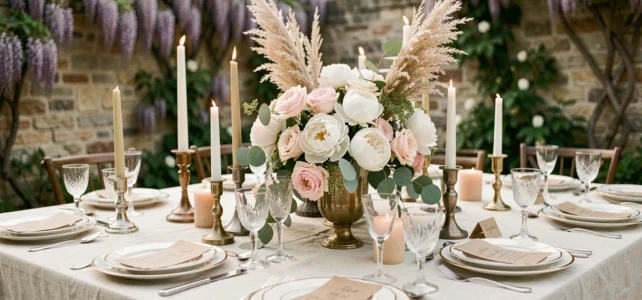
Decorating a wedding often comes down to choosing between two opposing approaches: accumulating decorative elements to create a spectacular effect, or selecting a few strong pieces that carry the ambiance on their own. Recent trends clearly lean towards the second option, with an aesthetic described as “old money” by industry professionals. Understanding what concretely distinguishes these two logics allows for making wedding decoration choices that endure over time, both in photos and in memory.
60-30-10 Rule Applied to Wedding Table Decoration
Interior design has long used the 60-30-10 composition rule to balance a color palette. When applied to a wedding table, it structures choices instead of leaving them to chance.
The principle: a dominant color covers about 60% of the visual surface (tablecloth, runner), a secondary color occupies 30% (napkins, dishes, chairs), and an accent color punctuates the remaining 10% (candles, small stationery items, floral details).
| Component | Visual Share | Concrete Examples |
|---|---|---|
| Dominant | 60% | Natural linen tablecloth, beige runner |
| Secondary | 30% | Terracotta cotton napkins, stoneware plates |
| Accent | 10% | Amber candles, printed menu, small blown glass vase |
This grid prevents a common pitfall: multiplying colors “to make it pretty” and ending up with a visually cluttered result. Three dominant materials per table are sufficient (linen, stoneware, and wood, or brushed metal, glass, and cotton) to create a coherence that the eye perceives immediately, even without design training.
Seasonal palettes reinforce this logic. An autumn wedding benefits from pairing terracotta, burgundy, and mustard on a washed linen base, while a summer wedding can play with warm neutrals enhanced by a sage or apricot accent. Rather than scrolling through hundreds of images on Pinterest, starting from this structure significantly reduces the number of decisions to be made.
Chic Minimalism vs. Overloaded Decor: What the “Old Money” Style Changes
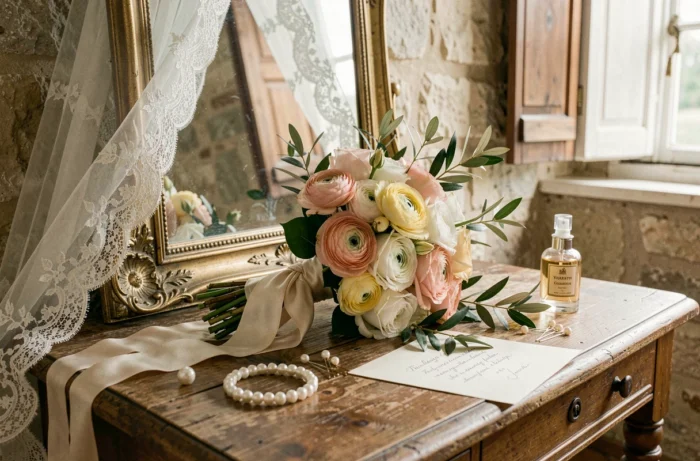
The post-Covid trend has gradually moved away from heavily loaded decorations. This movement, described as a return to discreet elegance with few elements but noble materials, redefines what is considered a successful wedding decoration.
Concretely, this means preferring beautiful brass candlesticks to a forest of tealights, hand-blown glassware instead of standard rental glasses, and linen tablecloths rather than satin polyester. Every object placed on the table must justify its presence through its quality or uniqueness. By browsing the decor offered by Rêve 2 Mariage, one can clearly see this shift towards carefully chosen pieces rather than accumulation.
This choice has a direct effect on the budget. Fewer decorative elements do not necessarily mean cheaper, as the cost shifts towards the unit quality of each piece. However, the photographic result improves significantly: a clean table with beautiful lighting produces more timeless images than an overloaded decor that visually dates within a few years.
Wedding Decoration with Thrifted Items: Beyond Simple Vintage Accents
Vintage in wedding decoration has long meant “a few old suitcases stacked near the guest book.” The recent approach goes much further, with a curated collection of second-hand items forming the very foundation of the decoration, not just a simple accessory.
Resale platforms among brides and specialized flea markets now allow for creating a coherent ensemble: mismatched but color-harmonious tableware, copper candlesticks of varying heights, 1970s smoked glass vases. The result has a character that standardized rental decor cannot replicate.
- Mismatched tableware: pairing plates of different shapes but within the same color range (off-white, cream, ivory) creates a refined “family table” effect
- Antique candlesticks and holders: mixing heights and materials (brass, tin, glass) adds depth without cluttering
- Reclaimed textiles: vintage lace doilies or already patinated linen napkins provide a texture that new items cannot imitate
- Floral containers: stoneware jars, ceramic pitchers, or amber glass bottles replace uniform transparent vases
This approach requires time for research, often several months before the wedding. The gain is both aesthetic and budgetary, as the overall cost of decoration significantly decreases with second-hand items.
Lighting and Ceremony Arch: Two Elements That Define the Atmosphere
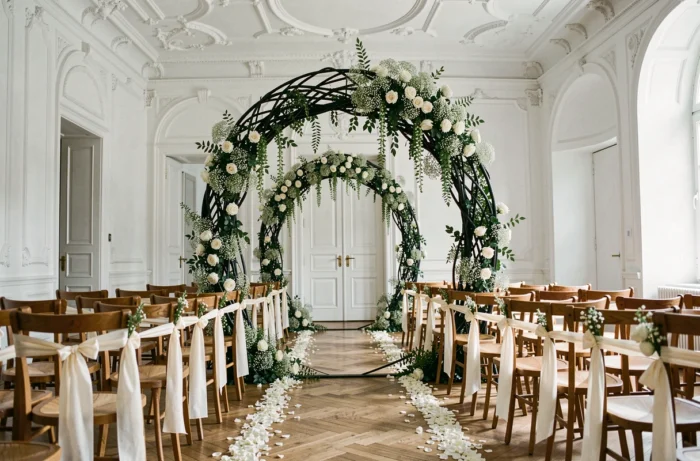
Among all the decoration elements, two have a disproportionate impact on guests’ feelings: the lighting of the reception hall and the ceremony arch.
Lighting transforms any venue. String lights with filament suspended in a canopy above the tables, combined with candles at different heights, produce a warm and flattering light that neon lights never will. Beautiful lighting alone compensates for a sober decor, while cold or harsh lighting ruins even the most ambitious decorative efforts.
The ceremony arch, on the other hand, focuses visual and photographic attention on a single point. The most striking versions currently rely on simple structures (raw wood, forged metal) dressed with dried flowers or asymmetrical foliage rather than classic symmetrical floral arrangements.
- Warm filament string lights (Edison type) suspended in parallel lines or as a canopy
- Pillar candles of varying heights grouped in clusters on tables and on the floor
- Weathered metal lanterns placed along the ceremony aisle
Choosing to invest in these two elements rather than spreading the budget across many small decorative items directly reflects the minimalist logic described above. Two or three well-thought-out decisions about lighting and the ceremony focal point yield a more coherent result than a dozen micro-choices scattered throughout.
The most memorable wedding decoration is not the one that contains the most objects, but the one where each element has been chosen for a specific reason. Starting from a composition rule, limiting materials, prioritizing the quality of pieces over their quantity, and concentrating the budget on lighting and the focal point: these few decisions are enough to create an atmosphere that guests will spontaneously describe as elegant.