
The removal of the self-consumption bonus for connection requests submitted since June 5, 2026, and the drop in the surplus buyback rate to 1.1 euro cent per kWh excluding tax radically changes the economic equation of residential solar energy. Producing solar energy remains a powerful lever to reduce your electricity bill, but the profitability calculation no longer relies on the same parameters as it did two years ago.
Tariff Reform 2026 and Impact on Solar Profitability
The tariff order of June 1, 2026, published in the Official Journal on June 4, has ended the self-consumption bonus for any new connection requests. At the same time, the surplus buyback rate has dropped from about 4 cents to 1.1 cents per kWh excluding tax. In practical terms, each kilowatt-hour injected into the grid now earns very little.
This development means that the value of solar is almost entirely focused on the self-consumed kWh. A kilowatt-hour that you consume directly avoids purchasing at the supplier’s rate, which remains significantly higher than the buyback cent. The difference between these two values has never been wider, and this is where the actual reduction of your electricity bill takes place.
We recommend no longer thinking in terms of “solar income” but rather in terms of avoided costs. Simulators that still display high resale revenues are likely using outdated pricing grids. Always check the reference date of the rates, especially on energiesolaires.fr where pricing data is regularly updated.
Photovoltaic Self-Consumption: Increasing the Rate to Compensate for the End of Bonuses
With a nearly symbolic surplus buyback, the self-consumption rate becomes the only relevant financial performance indicator. A household that self-consumes the majority of its production derives a real benefit from its installation. Those who inject massively into the grid see their profitability collapse.

Several technical levers can help increase this self-consumption rate:
- Managing heavy loads (water heaters, washing machines, dishwashers, electric vehicle charging) during solar production hours, using time switches or solar routers.
- Installing a home battery, whose profitability directly depends on the gap between the grid kWh cost and the storage cost per cycle. We observe that this gap is starting to become favorable in certain configurations, but the calculation remains tight.
- Proper sizing of the installation: it is better to have a slightly lower peak power than daytime consumption than to oversize, which generates nearly free surplus for the grid.
Oversizing a residential installation no longer makes economic sense since the reform. Before 2026, a significant surplus was compensated by a decent buyback rate. This is no longer the case.
End of Total Sale for Solar Installations of 9 kWc or Less
Since March 28, 2025, total sale is no longer open to installations of 9 kWc or less. This regulatory change, resulting from a modifying order of March 26, 2025, completely eliminates the model where an individual had photovoltaic panels installed without consuming a single kWh of their production.
For residential projects of this power, the only legally valid scheme is self-consumption with surplus sale. Any commercial proposal that presents a total sale arrangement for an installation of 9 kWc or less on a new connection is therefore void.
This point is often overlooked in popular articles that still compare “total sale vs self-consumption.” The comparison is no longer legally relevant for small residential powers. We find that some installers continue to present these two options, which creates confusion among individuals.
Photovoltaic Panels and Protection Against Rising Electricity Prices
Beyond the immediate bill reduction, solar energy acts as a hedge against changes in regulated tariffs. The kWh you produce has a fixed cost, defined at the time of the initial investment. It does not follow annual tariff revisions.
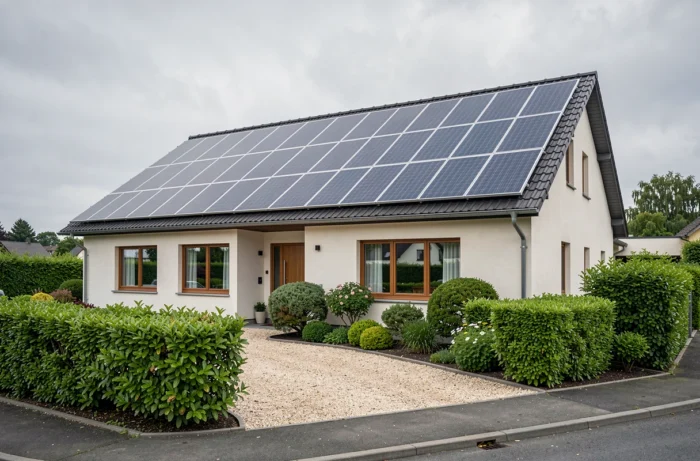
This protection is even more significant as the cost of grid electricity has seen repeated increases in recent years. Each increase in the supplier’s rate mechanically improves the value of the self-consumed kWh, without you having to do anything.
The amortization calculation of a photovoltaic installation must include an assumption about the evolution of electricity prices. With the surplus buyback rate now negligible, it is the trajectory of the grid price that determines the actual payback period.
Technical Criteria for a Profitable Solar Investment in 2026
The regulatory context requires refocusing the analysis on a few decisive parameters before committing:
- The daytime consumption profile: a household with daytime presence (teleworking, retirement, EV charging) values its production better than a household absent from 8 a.m. to 7 p.m.
- The orientation and inclination of the roof: a south-facing exposure with a slope around 30 degrees remains the suitable configuration in mainland France, but an east-west orientation can smooth production throughout the day and improve the self-consumption rate.
- The carbon footprint of the modules: new regulatory requirements mention criteria related to carbon footprint and panel composition. Ensure that your installer offers modules compliant with current standards.
- The peak power must be calibrated to actual consumption, not to the available roof area. A serious quote starts from the analysis of bills, not from the number of exploitable square meters.
Solar energy remains a solid investment for sustainably reducing your electricity bill. The disappearance of bonuses and the drop in the buyback rate do not undermine the value of photovoltaics; they shift the value towards direct self-consumption. A well-sized project, adapted to your consumption profile and compliant with the 2026 regulatory framework, generates concrete savings from the first year of operation.