
Your phone suggests a response before you even finish reading the message. Your smartwatch detects an unusual heart rate and alerts you. These micro-events, now commonplace, rely on rapidly evolving technological layers. This year’s high-tech trends are not just about new gadgets: they are reshaping how software, objects, and the rules of the game interact.
European AI Act: the regulation that changes the game for innovation
Have you noticed that artificial intelligence applications are increasingly displaying legal notices? It’s not a coincidence. The AI Act, the European regulation on artificial intelligence that came into effect in August 2024, will be fully applicable in August 2026.
Any company using an AI system classified as “high risk” (automated recruitment, banking scoring, assisted medical diagnosis) must now document its uses and ensure human validation. Organizations in France and elsewhere in Europe are formalizing internal policies, appointing AI referents, and auditing their models.
This regulatory framework has a direct effect on innovation: it pushes software publishers to integrate transparency from the design stage. French start-ups developing AI solutions are adapting their roadmaps to anticipate these obligations rather than facing them after the fact. To learn more about Officiel News, the tech section regularly covers these regulatory developments and their concrete impacts.
Artificial intelligence in business: concrete gains rather than promises
The most documented experiences this year show that the most adopted AI uses are operational and discreet. Far from showroom demonstrations, it is everyday tasks that are truly changing thanks to artificial intelligence:
- Document writing and summarization: meeting minutes, internal reports, monitoring notes generated in minutes instead of several hours.
- Enhanced customer support: human agents receive contextualized response suggestions, reducing processing time without eliminating human interaction.
- Commercial qualification: sales teams use AI models to prioritize leads based on their actual behavior, not their intuition.
- Automated reporting: real-time dashboards with alerts on anomalies instead of Excel files compiled manually every Friday.
The common point? AI does not replace a job; it absorbs repetitive tasks to free up time for analysis and decision-making. Projects that stall are no longer blocked by the technology itself but by governance: who validates the results, who is responsible in case of error, how to secure the data.
AI Governance: the real barrier is not technical
Several analyses published this year converge on this observation: AI projects fail more due to a lack of organizational alignment than due to model limitations. A company may have a high-performing algorithm and never deploy it because roles are not defined, validation processes are nonexistent, or data security is insufficient.
For tech teams in France, this means that the most sought-after skill around AI is no longer prompt engineering but the ability to structure a reliable deployment framework. Hybrid profiles, capable of communicating with both developers and business leaders, are taking on a strategic role.
Smart glasses and immersive interfaces: beyond the gadget
Do you remember Google Glass in 2013? The concept seemed premature. More than a decade later, smart glasses are making a comeback with stronger arguments.
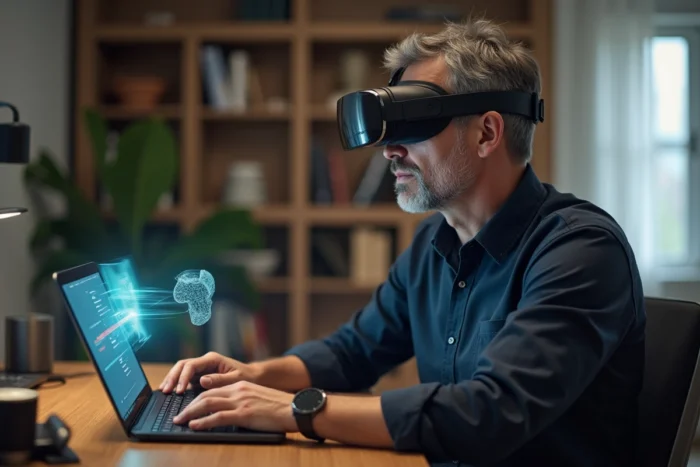
The models presented this year at CES 2026 and during European trade shows integrate contextual AI functions: real-time translation displayed in the field of vision, pedestrian navigation overlaid on the landscape, notifications filtered according to context (meeting, driving, leisure). Smart glasses are becoming credible for everyday use, not just for stage demonstrations.
At the same time, volumetric video is progressing. This technology allows for capturing a scene in three dimensions, giving the viewer the ability to choose their angle of view during playback. Sports are the first visible application area: imagine watching a rugby match while selecting the camera, angle, and slow motion yourself.
Domestic robots and autonomous mowers with LiDAR sensors
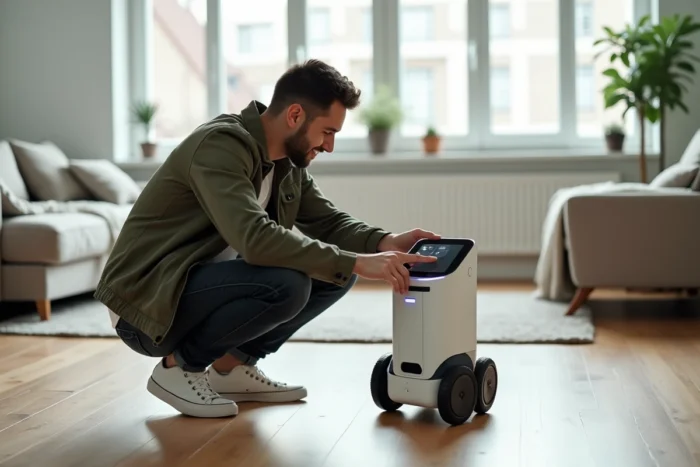
Another strong signal from CES 2026: garden robots equipped with LiDAR sensors. LiDAR is the laser-based remote sensing technology used in autonomous cars. When applied to a mower, it allows for precise terrain mapping, obstacle avoidance, and operation without buried peripheral wires.
This is not a niche gadget. LiDAR robotic mowers eliminate the most cumbersome installation of older models: the boundary wire, which is time-consuming to lay and fragile. The result is quick commissioning and more precise mowing, even on uneven terrain.
Tech sovereignty in France and Europe: a strategic priority
Dependence on American and Chinese tech giants is no longer just a political debate. It is becoming a concrete decision criterion for French companies and administrations.
At VivaTech 2026, several European start-ups presented sovereign alternatives in cloud computing, cybersecurity, and language models. The goal is not to start from scratch but to build what some analysts call “resilient interdependence”: using global tools while mastering critical building blocks (hosting sensitive data, AI models trained on datasets compliant with European law).
For users, this translates into clearer choices. Management software hosted in France, an AI assistant compliant with GDPR, a SecNumCloud certified cloud: these labels, still confidential two years ago, are becoming visible commercial arguments.
The AI Act, the operational gains of AI, immersive interfaces, and digital sovereignty outline a year where the technologies that matter are those that find their place in real processes, with clear rules and measurable results.