Monaco is home to around 38,000 residents in just over two square kilometers. This density, among the highest in the world, creates a lifestyle where physical proximity dictates habits: shopping, work, school, and leisure are often just a few minutes’ walk away. Understanding daily life in Monaco requires looking beyond the postcard to see how this urban compression concretely shapes each day.
Sustainable mobility and pedestrian corridors: what’s changing in Monaco
Classic guides describe Monaco as a compact city where everything is accessible on foot. This is true, but the Principality is undergoing a significant transformation of its public spaces that is already changing the daily routes of residents.
The “Renaturer la Ville” strategy, documented by the Monegasque government, targets several busy areas. Princess Grace Avenue is undergoing a project to widen sidewalks, add dedicated bike lanes, create green walls, and install charging stations for electric taxis and buses. The Sculpture Path in Fontvieille plans to introduce new large trees, rest areas, and pedestrian pathways designed as urban relaxation spots in response to climate change.
Belgium Boulevard, between the Exotic Garden and Bougainvillea Square, is set to become a green pedestrian corridor with shaded paths connecting the elevated neighborhoods. These projects remain strategic guidelines, not finalized execution plans, but they reflect a clear shift: daily life in Monaco now incorporates climate comfort (shade, cool spots) and sustainable mobility in heavily trafficked streets.
For residents, this means that commuting habits will evolve. Walking or cycling in today’s narrow, mineral streets will gradually become more enjoyable, especially in summer. This information, accessible by consulting official documents or browsing local resources like discovering the Petit Monégasque site, allows for tracking these on-the-ground changes.
Shuttles, elevators, and buses: daily transport in the Principality
Monaco does not operate like a typical city when it comes to transportation. The bus network of the Compagnie des Autobus de Monaco covers the entire territory with short and frequent lines. Journeys rarely exceed a few minutes.
The steep terrain of the Principality has led authorities to install a network of public elevators and escalators that connect different levels of the city. These vertical infrastructures, free and open continuously, are a daily reflex for residents, much more so than cars in many cases.
- Bus lines serve all neighborhoods, from Fontvieille to Larvotto, with frequencies adapted to the peak hours of cross-border workers.
- Public elevators allow for effortless transitions between street levels, making walking feasible even in the steepest areas.
- The train connects Monaco to Nice in about twenty minutes, making it a common option for outings, shopping, or medical appointments outside the Principality.
One point that guides mention little: tens of thousands of cross-border workers enter each morning from France and Italy, then leave at the end of the day. This flow creates a very marked urban rhythm, with a city that densifies significantly between eight and six, then returns to relative calm in the evening.
Language and social integration in Monegasque life
French is the official language and the dominant working language in Monaco. Administrative procedures, exchanges with merchants, condominium meetings: everything is done in French. Mastery of this language is a practical prerequisite, not just theoretical.
Italian remains very present in everyday conversations, a legacy of geographical proximity and the strong resident Italian community. English is widely understood in business and hospitality settings, but daily life remains Francophone.
Social integration occurs through a phenomenon unique to micro-states: the repetition of places. Residents frequent the same bakeries, gyms, and cafes, creating rapid familiarity. Monegasques, a minority in their own country, coexist with over a hundred nationalities. This mosaic produces a cosmopolitan atmosphere on a village scale.
Local events and community fabric
Monaco organizes a dense calendar of events throughout the year, from the Grand Prix to concerts and national holidays. These gatherings punctuate social life and often serve as the primary means of integration for newcomers.
The associative fabric is active: sports clubs, cultural associations, and community groups by nationality offer concrete entry points. Participating in an association remains the most direct way to build a social network outside of the professional sphere.
Practical cost of living in Monaco: beyond real estate
Real estate dominates discussions about the cost of living in Monaco, and prices per square meter are among the highest in the world. But the daily budget is not limited to rent.
Grocery prices are significantly higher than in neighboring France. Many residents regularly shop in Cap-d’Ail or Beausoleil, neighboring French towns accessible within a few minutes on foot. This habit is commonplace and does not stem from resourcefulness: it is a structural habit.
- Restaurants have high prices in tourist areas (Monte-Carlo, the port), but La Condamine and Fontvieille offer more accessible options.
- Healthcare benefits from an efficient system, with the Princess Grace Hospital Center as the reference facility.
- The absence of income tax for residents (except for French nationals subject to the Franco-Monegasque tax treaty) partially offsets the daily extra costs.
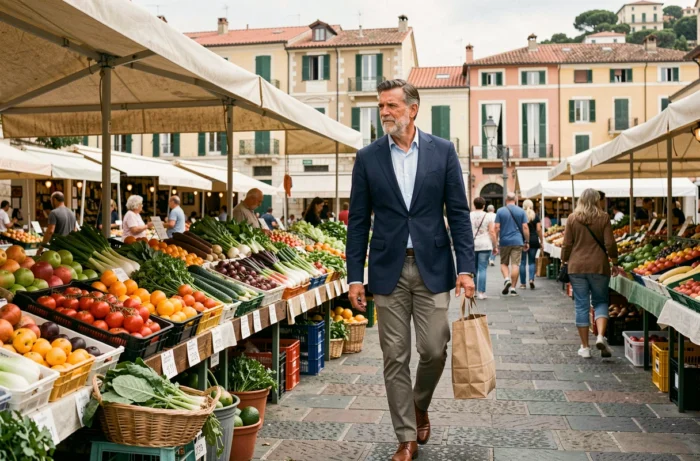
The Condamine market, open every morning, remains a landmark for residents seeking fresh products at more reasonable prices than in the central supermarkets.
Living in Monaco daily relies on a series of micro-adjustments that newcomers acquire within a few weeks: knowing which elevator shortens a journey, which market offers the best value for money, which neighborhood regains its calm after six. The Principality functions like a dense village where routine is optimized through repetition, not distance.