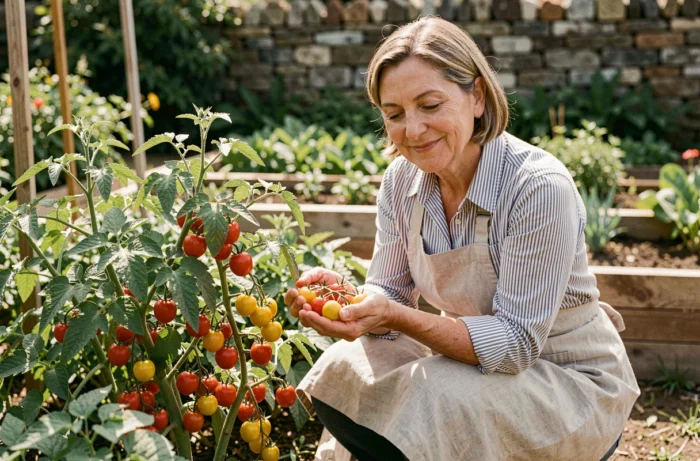
When gardening in a windy plot, a narrow balcony, or simply without the desire to plant stakes every spring, stake-free tomatoes change the game. These determinate or sprawling varieties produce on short, sturdy stems that stand on their own. Their growth naturally stops after a few clusters of fruit, which concentrates the harvest over a few weeks and limits the size of the plants.
Determinate growth and dwarf genetics: what truly eliminates the need for staking
Not all so-called “easy” tomatoes can do without a stake. The distinction lies in the type of growth. An indeterminate plant continues to grow as long as conditions allow, sometimes exceeding two meters. Without support, it breaks or sprawls on the ground, exposing its fruit to moisture and slugs.
A plant with determinate growth stops its growth after a few floral tiers. The stems remain stout, and the dense foliage protects the fruit from direct sunlight. Result: no need for a stake or string.
In recent years, the Dwarf Tomato Project has developed dwarf lines specifically selected for thick foliage, short stems, and concentrated fruiting. This international collaborative work has produced varieties suitable for small spaces, including pot cultivation on balconies. You can explore stake-free tomato varieties to identify those that fit each garden configuration.
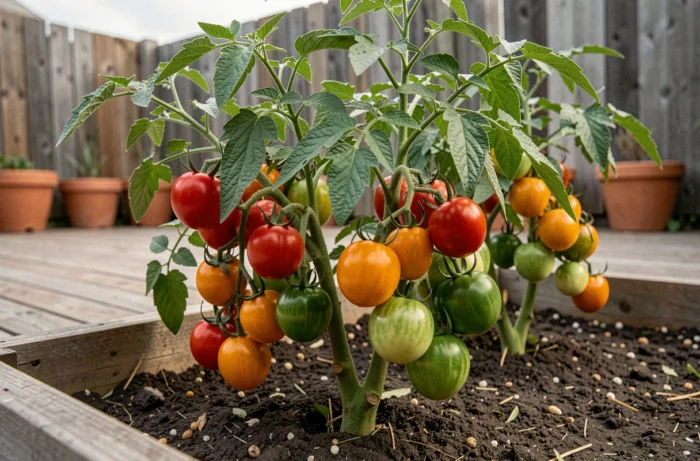
Red, yellow, and cherry bush tomatoes: reliable varieties for the garden
Rather than listing ten names without context, let’s focus on those that frequently appear in feedback from gardeners and organic seed catalogs.
Roma: the reliable choice for sauces
Roma remains the benchmark for stake-free tomatoes for processing. Its elongated, meaty fruits contain few seeds and little juice. It is suitable for purees and preserves. Its compact growth makes it suitable for tight rows or garden borders.
Petit Pomme Rouge and bush cherry tomatoes
For snacking and salads, Petit Pomme Rouge produces small round fruits on a stout plant. Determinate cherry tomatoes like Tumbling Tom also work well in hanging baskets or window boxes. Tumbling Tom is one of the few cherries truly suited for pots and balconies, thanks to its trailing stems that do not exceed a few dozen centimeters.
Rutgers: fresh consumption and versatility
Less known in France, Rutgers is an American variety appreciated both raw and cooked. Its bushy growth makes it usable without a stake in open ground. It tolerates watering variations better than most large tomatoes, making it a relevant choice for a garden where one is not present every day.
Diseases and resistance to blight: a often overlooked selection criterion
People often choose a stake-free tomato to simplify maintenance. But without disease resistance, the time savings quickly disappear when blight sets in after a week of rain in July.
Determinate varieties have a structural advantage: their grouped and early harvest often allows them to avoid the blight peaks that occur at the end of summer. Where an indeterminate plant produces until October (and remains exposed for months), a bushy plant concentrates its fruit over a few weeks.
On the health evolution side, the Tomato Brown Rugose Fruit Virus (ToBRFV) has become a major concern in tomato production. Recent hybrids like Serenity, Luminity, or Grandice RES incorporate specific resistance to this virus. These varieties, initially intended for professional market gardening, are described as controlled growth plants usable in open fields with simplified management. Feedback varies on their availability for amateur gardeners, but this trend should gradually spread to consumer catalogs.
Pot culture, in-ground, or in raised beds: adapting the variety to the container
The choice of container alters the behavior of the plant. In pots, the limited soil volume hinders root growth and reduces the final size of the plant, which enhances the interest in dwarf varieties.
- In pots or window boxes (balcony, terrace): prefer trailing cherries like Tumbling Tom or dwarfs from the Dwarf Tomato Project, which remain compact even with reduced substrate.
- In open ground, tight rows: Roma and Rutgers accept shorter spacings than indeterminate varieties, freeing up space for other crops.
- In raised beds: classic bush varieties (Petit Pomme Rouge, mixes of bush tomatoes offered by organic seed suppliers) benefit from the depth of the bed while remaining low.
Mulching at the base of sprawling plants protects the fruit from direct contact with the soil. Without this precaution, tomatoes touching the damp ground quickly develop rot, especially after rain. Straw, mulch, or even cardboard is sufficient.
Sowing, harvesting, and reduced maintenance: what really changes without staking
The removal of the stake does not change the sowing date or water needs. These varieties are sown indoors in spring, transplanted after the last frosts, and watered regularly at the base.
What changes concretely:
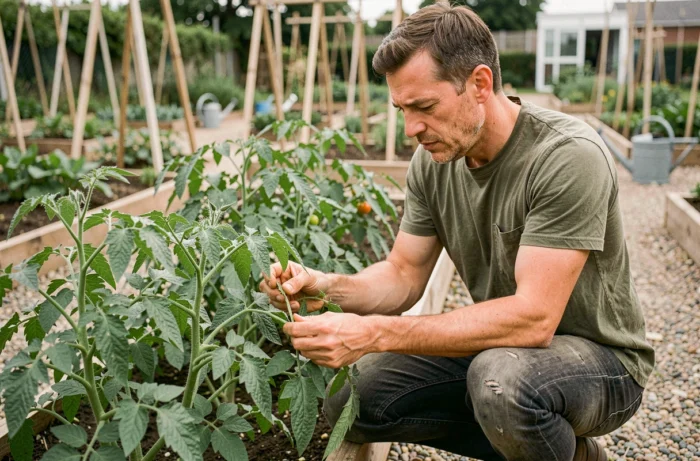
- No pinching of suckers on most determinate varieties. The plant manages its branching on its own.
- No tying or weekly checking of ties, which represents a real time savings on a dozen plants.
- The harvest is concentrated over a few weeks. To spread production, one can plant several bush varieties with different maturities.
- A well-fed determinate plant at the start gives the bulk of its harvest without intervention, provided the soil has been properly amended before planting.
Growing without stakes is not suitable for all projects. For those wanting giant tomatoes like Cœur de Bœuf or harvests spread until the first frosts, staking remains necessary. Bush varieties cater to those who want fruit without complication, in a limited space or with limited gardening time. It is a trade-off between maximum yield and simplicity, and for many family gardens, simplicity wins out.