
Social and solidarity tourism accounts for several million holidaymakers each year in France and generates a turnover of around one billion euros. This structuring segment of the tourism economy far exceeds the “committed” niche described by most responsible holiday guides. Identifying solidarity and ethical accommodations that deserve attention requires looking beyond the labels displayed in the window.
Carbon footprint of tourist accommodations: the criterion that rankings ignore
According to ADEME, tourist accommodations represent about 8% of greenhouse gas emissions from tourism in France. This figure places accommodation as a priority lever for a responsible holiday policy, well before the choice of an activity on-site or the purchase of local products.
The majority of “top” ethical accommodations focus on architectural design, bio-sourced materials, or the presence of a vegetable garden. These elements are visible, photographable, but say nothing about the energy aspect, which remains the primary contributor to emissions at a hosting location. We recommend checking three points before making any reservation:
- The main heating method (heat pump, local wood, urban network) and the share of renewable energies in electricity consumption
- The water management policy (rainwater recovery, flow limitation, phyto-purification treatment)
- The energy performance diagnosis of the building, when accessible, which remains the only standardized comparable indicator from one accommodation to another
An association-run holiday village heated with fuel oil in a poorly insulated building can display an exemplary ethical charter while emitting more than a renovated classic hotel. The actual carbon footprint takes precedence over responsible communication.

Environmental labels in solidarity accommodation: Green Key, Ecolabel and beyond
The Green Key remains the world’s leading eco-label for tourist accommodations. In France, the number of certified establishments has markedly increased in recent years, with growing territorialization: some regions now concentrate a notable density of certified structures, while others remain under-equipped.
The European Ecolabel, more demanding regarding water and energy consumption criteria, concerns a smaller number of establishments. A label does not guarantee the solidarity aspect of an accommodation. Green Key and Ecolabel measure environmental impact, not social anchoring or local economic redistribution.
For structures that fall under social and solidarity tourism (association-run holiday villages, family homes, centers managed by social and solidarity economy actors), belonging to a federative network acts as a guarantee. Among the accommodations like camping la gare des amis, there are places where the mission of welcoming audiences distanced from holidays structures the economic model, not just the “commitments” line on the website.
Cross-referencing environmental label and solidarity status
We observe that the most coherent structures combine a verifiable environmental label with an associative or cooperative status. This intersection remains rare. Most eco-responsible booking platforms (GreenGo, Les Oiseaux de Passage, Vaovert) filter by ecological criteria but do not distinguish the legal status or governance model of the host.
Checking the legal status of the hosting structure (association law 1901, SCOP, SCIC) provides more reliable information on profit redistribution than any “solidarity” pictogram on a booking sheet.
Ethical booking platforms in France: what filters really do
GreenGo, Hortense, Les Oiseaux de Passage, Fairbnb, Vaovert, Tookki: the landscape of responsible booking platforms has become denser. Each applies its own selection criteria, and filtering criteria vary significantly from one platform to another.
GreenGo favors small-capacity accommodations with a strong territorial anchoring. Hortense targets a high-end eco-responsible positioning. Les Oiseaux de Passage stand out with a filter on the human and social commitment of the place, not just its environmental performance. Fairbnb donates part of its commissions to local community projects.
A common trap: assuming that an accommodation listed on an ethical platform is automatically solidarity-based. Presence on GreenGo or Vaovert attests to environmental practices, not to a redistributive economic model. For holidaymakers specifically seeking the solidarity dimension, networks of social tourism (UNAT, family tourism associations) remain more relevant than generalist green platforms.
Solidarity accommodation and price accessibility: the structural link
Solidarity accommodation in France has historically carried a mission of accessibility to holidays for excluded audiences: low-income families, people with disabilities, young people in integration. This social vocation distinguishes solidarity accommodation from simply ecological accommodation.
Association-run holiday villages, vacation centers managed by mutuals or works councils, and family homes apply pricing grids indexed to family quotients. This price solidarity mechanism does not exist on any classic eco-responsible booking platform.
How to recognize truly solidarity accommodation
Three reliable markers allow distinguishing solidarity accommodation from accommodation that uses the word without grounding it:
- A social tourism approval granted by the State or recognition by UNAT (National Union of Tourism Associations)
- A pricing structure adjusted according to the resources of holidaymakers, with acceptance of CAF holiday vouchers or ANCV holiday checks
- An associative or cooperative governance, with volunteer administrators or members involved in decisions
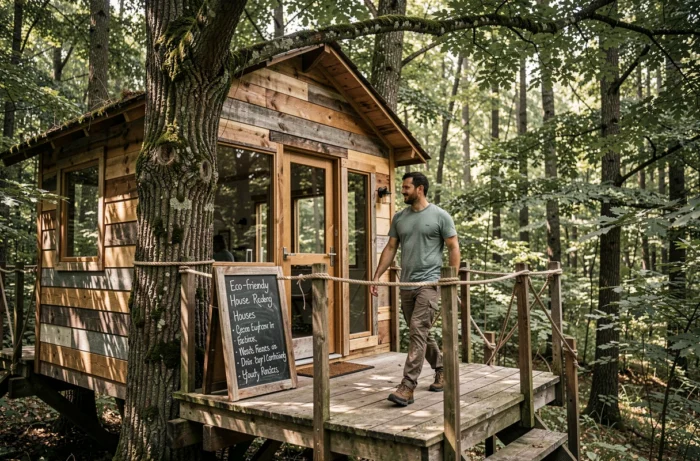
These criteria do not appear in any online platform filters. They require manual verification, which explains why solidarity tourism remains underrepresented in search results compared to eco-lodges and designer cabins that dominate the rankings.
The social and solidarity tourism sector employs several tens of thousands of people in France. Choosing this type of accommodation for responsible holidays directly finances a model where the right to holidays for all structures economic activity, not just the commercial brochure.