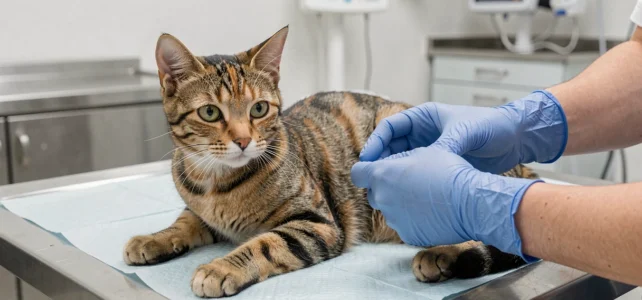
The descent of the testicles in cats follows a precise schedule, conditioned by hormonal and anatomical mechanisms. When this process fails, it is referred to as cryptorchidism, an anomaly whose frequency, diagnostic timelines, and consequences vary depending on whether one or both testicles are affected. This article measures these discrepancies and details concrete guidelines for taking action at the right time.
Unilateral or bilateral cryptorchidism in cats: a comparison of clinical forms
The distinction between the two forms of cryptorchidism determines the prognosis, the type of surgical intervention, and the residual fertility of the cat. The table below summarizes the documented differences.
| Criterion | Unilateral cryptorchidism | Bilateral cryptorchidism |
|---|---|---|
| Relative frequency | Most common form | Rarer |
| Testicle(s) in scrotal position | One | None |
| Location of the retained testicle | Abdomen or inguinal canal | Abdomen or inguinal canal (both) |
| Fertility | Partially preserved (functional scrotal testicle) | Most often sterile |
| Tumor risk | Present on the ectopic testicle | Present on both ectopic testicles |
| Castration recommended | Yes | Yes |
A cat with unilateral cryptorchidism retains reproductive capacity through the descended testicle. This is precisely what poses a problem: a fertile cryptorchid cat can transmit the anomaly, as the hereditary component is documented. Castration aims to protect the animal’s health as well as to prevent the spread of the gene in a lineage.
To understand the descent of the testicles on AlmAnimal, one must return to the embryonic mechanism: the testicles form near the kidneys and then migrate to the scrotum via a fibrous structure called the gubernaculum testis, under the influence of hormonal signals.

Diagnostic window: when is testicular descent considered definitive?
Publicly available content places the descent of the testicles in cats within the first weeks of life, with completion expected by around two months of age. This reference is correct physiologically, but it does not reflect the entirety of the observation window used in practice.
Within feline enthusiast circles (breed clubs, show judges), it is accepted that a young male cat may still see its testicles complete their descent until about eight to ten months, due to hormonal changes related to puberty. Beyond this threshold, cryptorchidism is considered acquired.
Consequences for the veterinary calendar
This waiting margin has a direct impact on decision-making. A veterinarian who palpates a three-month-old kitten and detects only one testicle does not necessarily diagnose definitive cryptorchidism. They may suggest a follow-up a few months later.
On the other hand, if at ten months the testicle is still not in the scrotal position, surgery becomes the standard recommendation. Delaying the intervention beyond this window increases the risk of complications, including testicular torsion or tumor development.
Location of the ectopic testicle and choice of surgical castration
The position of the retained testicle determines the surgical technique. Two main situations arise:
- The testicle is trapped in the inguinal canal, that is, in the groin area. Castration is then performed through an inguinal incision, similar to a classic castration with slightly modified access.
- The testicle has remained in the abdomen, close to its embryonic position near the kidneys. The procedure requires abdominal surgery, which is more invasive, sometimes assisted by preoperative ultrasound to precisely locate the organ.
- In rare cases, the testicle is found in a subcutaneous position, outside the inguinal canal but not in the abdomen. Careful palpation can then locate it without imaging.
Ultrasound is the reference examination for locating a non-palpable testicle. It allows the surgeon to plan the surgical approach and reduce the duration of anesthesia.
Cost and variability of the intervention
The price of castration for a cryptorchid cat varies significantly depending on the location of the testicle and the need for additional examinations. An inguinal castration remains close to the standard rate, while an abdominal procedure, which is longer and more technical, can cost significantly more. The differences also depend on the clinic, the region, and any imaging used.

Exhibition and breeding rules regarding cryptorchidism
The main feline federations (WCF, FIFe, TICA, MFA) apply strict rules regarding cryptorchid males. A cat with both testicles not in the scrotal position is disqualified from exhibition and excluded from breeding programs.
This policy is based on the hereditary component of the anomaly. Allowing a cryptorchid male to reproduce means maintaining the gene in the genetic pool of a breed, with a risk of increasing prevalence over generations.
Breeder’s responsibility upon sale
When a purebred kitten is sold with a health certificate and cryptorchidism is diagnosed later, the question of warranty arises. Under French law, a hidden defect affecting a pet can give rise to a claim. The difficulty lies in the fact that the descent of the testicles may not be complete at the time of sale if the kitten is less than four months old.
A serious breeder mentions the state of the testicular descent in the veterinary certificate provided to the buyer. If there is any doubt, a veterinary check at six months and then at ten months allows for a resolution before the situation becomes contentious.
Crytorchidism in cats remains a manageable anomaly as long as it is identified in a timely manner. Surgical castration, adapted to the location of the retained testicle, eliminates the tumor risk and prevents hereditary transmission. The main point of vigilance concerns the timeline: do not conclude too early with a kitten of a few months, but do not wait beyond ten months to intervene.