
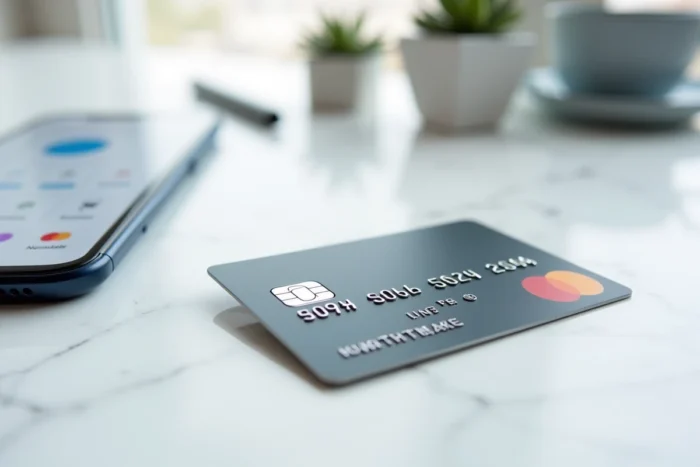
You make an online purchase, the amount is debited, and your checking account hasn’t moved a cent. This scenario describes a prepaid card. It looks like a regular card, often bearing the Visa or Mastercard logo, but operates on a different principle: you only spend the money loaded onto it, nothing more.
Payment account and reloading: what distinguishes a prepaid card from a debit card
Confusion is common. A debit card is linked to a checking account. Each transaction directly draws from the balance of that account. The prepaid card, on the other hand, works with a separate payment account that you fund before any spending.
In practice, you purchase the card (at a tobacco shop, online, at certain retailers), then you credit it with the desired amount via bank transfer, cash, or credit card depending on the issuer. As long as the balance is positive, you can pay in-store, online, or withdraw cash from ATMs. When the balance hits zero, the card simply declines the transaction.
To understand the functioning of a prepaid card, you need to remember this point: no overdraft is possible. The card ignores your banking history, your income, or your credit score. It is limited to the amount you have loaded.
This mechanism explains why no income verification is required at account opening. An ID is sufficient in most cases, making the card accessible to individuals with banking restrictions or accompanied minors.

Reloadable or disposable prepaid cards: two very different usage logics
Not all models are equal, as they do not serve the same need. The most significant distinction is between reloadable cards and non-reloadable cards.
Reloadable cards with client space
These are the most common for regular use. You have an online space (or an app) to track your transactions, check your balance, and reload the card. Some even offer an associated IBAN, allowing you to receive a transfer or set up a one-time direct debit.
A reloadable card with an IBAN is similar to a simplified bank account. It is suitable for individuals looking for a sustainable alternative to traditional banking, such as foreign workers in France or young people managing their first budget.
Non-reloadable cards
Sold with a fixed amount, they are depleted after use. They are often found in the form of gift cards. Their usefulness is limited in time: once the balance is consumed, the card becomes unusable.
Before choosing, ask yourself a simple question: will you use this card just once or for several months? The answer guides you toward one format or the other.
Hidden fees and limits: points to check before subscribing
The prepaid card appeals due to its simplicity, but its fees deserve careful reading. Unlike a traditional bank card with a clear annual fee, the fees for a prepaid card are spread across several categories.
- Activation or purchase fees for the card, charged once upon acquisition. The amount varies depending on the issuer and the network (Visa, Mastercard).
- Reloading fees, sometimes charged with each credit. Some issuers charge a percentage of the loaded amount, while others charge a fixed fee.
- Withdrawal fees at ATMs, often higher than those on a standard debit card, especially abroad.
- Inactivity fees if the card is not used for several consecutive months.
Limits are another parameter to monitor. Each card imposes a maximum amount for payments and withdrawals, per day and per month. These limits vary significantly from one issuer to another.
A point rarely detailed by comparison sites: anonymous prepaid cards are capped at a maximum of 150 euros in France, a direct consequence of anti-money laundering obligations. Once you exceed this threshold, the issuer requires complete identity verification. This regulatory framework significantly reduces the appeal of anonymous cards for substantial purchases.
Prepaid cards for businesses: a growing usage
Content about prepaid cards almost always focuses on individuals. However, businesses represent an increasingly significant area of usage.
The principle remains the same: a predefined envelope, no overdraft possible. Applied in a professional context, this results in cards assigned to employees with an individual limit for travel expenses, supply purchases, or software subscriptions.
The advantage for the company is twofold. Budget control is immediate, as each card does not allow exceeding its limit. And accounting management is simplified, as transactions are centralized on a single platform with automatic categorization.
For small businesses and freelancers, a professional prepaid card avoids the need to open a dedicated bank account with a traditional bank. It separates personal and professional expenses without heavy formalities.
Payments abroad and online purchases: where the prepaid card makes perfect sense
Traveling outside the euro zone and want to avoid exposing your checking account? The prepaid card limits the risk. In case of fraud or loss, only the loaded balance is at stake, not all your savings.
For online purchases, the reasoning is the same. You load the exact amount of your order, you pay, and the card no longer holds anything usable. This compartmentalization protects better than a simple payment limit.
- Travel: loading only the vacation budget limits financial exposure in case of theft.
- Online subscriptions: avoid forgotten direct debits by loading exactly the necessary amount.
- Purchases on lesser-known sites: do not provide the details of your main card.
The Visa and Mastercard networks cover almost all payment terminals worldwide. A prepaid card linked to one of these networks is accepted wherever the corresponding logo appears, whether in-store or online.
The prepaid bank card is neither a gadget nor a sub-bank product. It is a payment tool tailored for specific uses, from daily budget control to securing online transactions. Choosing the right model involves comparing actual fees, not just the displayed purchase price.