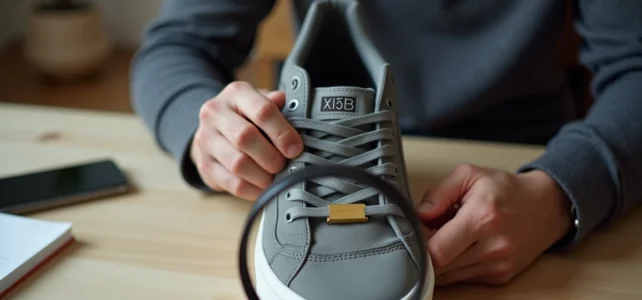
The Nike serial number, often referred to as SKU (Stock Keeping Unit), proves nothing on its own. A properly formatted code can be found on thousands of well-made counterfeits. We have observed for several seasons that counterfeiters reproduce perfectly consistent SKU codes, sometimes extracted directly from public databases. The issue is not just reading a code, but cross-referencing multiple layers of information to detect inconsistencies that counterfeiters have not yet mastered.
Technical Anatomy of the Nike SKU Code and Its Limits
A Nike SKU consists of a style code (usually six alphanumeric characters), followed by a dash and a color code (three digits). This pair identifies a specific model in a specific colorway. On the inner label of the shoe, this code coexists with the size, country of manufacture, and a UPC or EAN barcode.
A common trap is to only check that the SKU exists at Nike. A valid SKU does not guarantee that the pair it belongs to is authentic. Counterfeiters obtain real codes and apply them to fraudulent productions. We recommend never to consider the SKU as a verdict, but as a first-level filter.
Useful verification begins when we cross-reference the SKU with the actual colorway present on the shoe, the indicated size, and the mentioned country of manufacture. A pair displaying an SKU corresponding to a “University Red” colorway while the shoe is clearly orange is an immediate red flag. To authenticate Nike by serial number reliably, this cross-referencing step is non-negotiable.

Cross-Referencing Box, Label, and Shoe: The Method That Traps Fakes
The most credible counterfeits imitate the consistency of labels, not just the code. It is in this area that authentication becomes truly technical.
Three locations must carry identical information: the label affixed to the box, the inner label of the shoe (tongue or insole depending on the model), and, if applicable, the receipt or purchase invoice. Here are the concrete checkpoints:
- The SKU on the box must exactly match that of the inner label, including the dash and color code. A discrepancy of even one character invalidates the pair.
- The size mentioned on the inner label must match that of the box, in US, UK, and EU sizes simultaneously. Counterfeits often show incorrect size conversions between these three systems.
- The country of manufacture (Vietnam, China, Indonesia for most recent models) must be consistent across both supports. A model manufactured in Vietnam according to the inner label but mentioning China on the box poses an obvious problem.
- The font and spacing on the inner label must be regular. Fakes often exhibit irregular kerning, slightly too thick characters, or misalignment compared to standard Nike production labels.
We emphasize a detail that consumer guides often overlook: both shoes of an authentic pair carry the same serial number. Checking the consistency between the left and right shoe remains a simple yet remarkably effective test. Counterfeit pairs assembled from different lots sometimes display two distinct codes.
Verification Tools for Nike: App, GEPIR, and Barcode Databases
Google searching for an SKU is not a verification method. It can at best confirm that a model exists in the Nike catalog, without proving anything about the specific pair in question.
The Nike app does not offer a direct authenticity scan function for shoes. The UPC or EAN barcode can be verified through the GEPIR database (Global Electronic Party Information Registry), which identifies the legitimate owner of the code’s company prefix.
If the scan points to Nike Inc., the barcode is at least assigned to the brand. A barcode whose prefix does not correspond to any registered company, or that points to another manufacturer, indicates a counterfeit.
Third-party barcode scanning apps also allow reading the UPC and comparing it to associated product data. They verify that the code points to the correct model, colorway, and size. This verification does not replace physical inspection, but it adds a structured layer of control.
NFC Chip and QR Code on Recent Models
Nike is gradually incorporating NFC chips into certain product lines. When present, the NFC chip can be read with a compatible smartphone and links to a Nike page related to the product. The absence of an NFC chip on a model that is supposed to have one is a strong indicator of counterfeiting.
QR Codes printed on labels offer similar control. We recommend always scanning these codes before purchase on the secondary market, as counterfeiters visually reproduce the QR Code but rarely link it to a valid Nike URL.
Authentication Errors That Cost Dearly on the Secondary Market
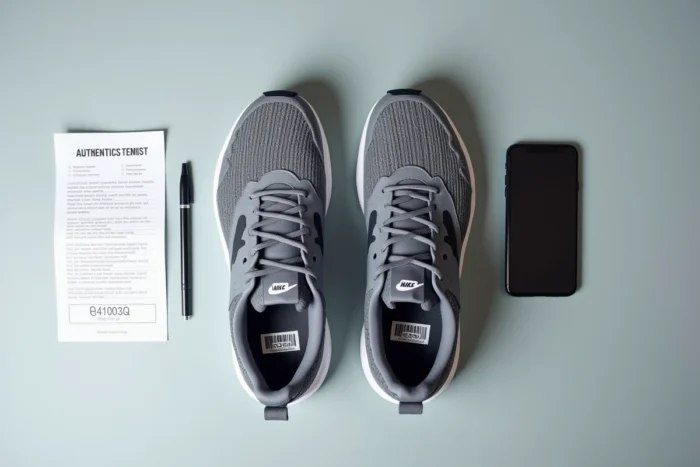
The sneaker resale market amplifies the risk. On peer-to-peer selling platforms, buyers often only have access to photos before purchase. Systematically requesting a clear photo of the inner label with the visible SKU, as well as a photo of the box label, already allows applying the cross-referencing described above.
A common mistake is to rely solely on the perceived quality of materials in photos. High-end counterfeits use materials visually similar to the originals. Only the cross-referencing of textual data and codes allows for remote verification.
Another trap: accepting a Nike purchase receipt as sufficient proof. Fake invoices circulate as much as fake pairs. A receipt whose SKU does not match that of the inner label is worthless.
Reliable authentication of a Nike pair relies on the accumulation of consistent checks, never on a single isolated criterion. The serial number opens the door, but it is the overall consistency between code, label, box, materials, and digital supports that closes the door to counterfeiting.