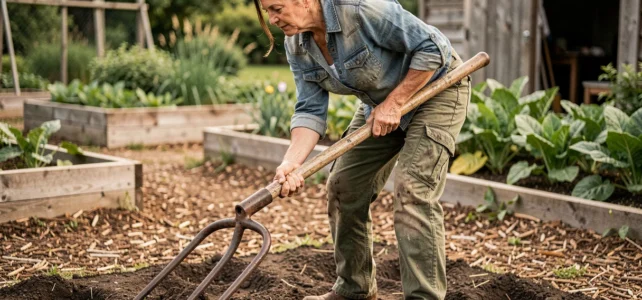
Between a three-pronged grelinette and a five-pronged model, the performance gap on clay soil is far from trivial. The grelinette, a soil decompacting tool that does not invert the soil, should not be chosen on a whim. Working width, shape of the tines, type of handles, nature of the terrain: each parameter affects the effort exerted and the results achieved in the vegetable garden.
This article measures the concrete differences between common configurations to identify what really makes a difference in the garden.
Grelinette on wet clay soil: why the tool reaches its limits
Most guides recommend the grelinette as a universal tool for ecological gardening. Field feedback nuances this statement, especially on heavy soils.
On overly wet clay soil, the tines do not crack the soil: they smooth it. This phenomenon, similar to mechanical smoothing, degrades the structure instead of aerating it. The passage of the grelinette then creates a compacted layer beneath the surface, exactly the opposite of the desired effect.
The so-called “drained” soil condition (the soil crumbles without sticking to the tines) remains the determining criterion. On clay soil, waiting two to three days without rain after a wet spell allows reaching this stage. The information available on grelinette-warrior.com details the soil conditions suitable for each type of grelinette.
For initial clearing or the extraction of deep roots, the grelinette does not replace a fork-spade. It is designed for already cultivated soil, where biological life has begun to structure the top few centimeters.
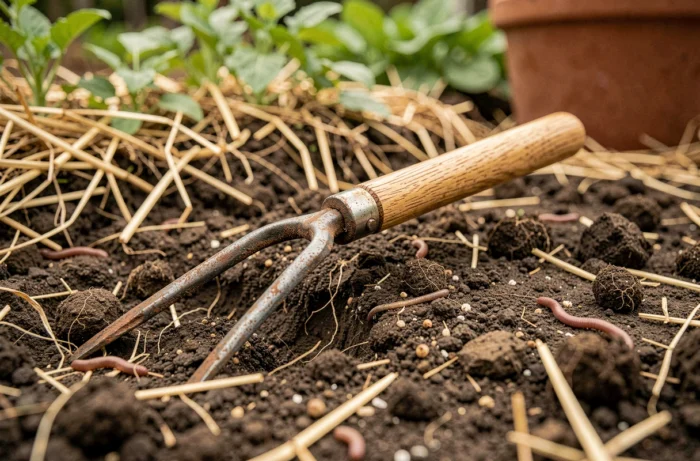
Grelinette comparison: tines, width, and handles against the terrain
Grelinette models vary along three main axes. Here is a summary table of common configurations and their suitability according to the context of use.
| Configuration | Working Width | Suitable Terrain | Effort Required |
|---|---|---|---|
| 3 tines | Narrow | Heavy, clayey soil, small plots | Moderate |
| 4 tines | Medium | Mixed soil, standard vegetable garden | Medium |
| 5 tines | Wide | Light, sandy soil, large areas | High on heavy soil |
A three-tine model traverses compact soil with less resistance. In contrast, a five-tine model covers more surface area per pass on loose soil. The number of tines should be chosen based on soil texture, not garden size.
Straight tines or curved tines
Curved tines penetrate compact soil more easily because the tip attacks the ground at an angle. On already loosened soil, straight tines are sufficient and provide a more direct lever movement.
Flared handles and grip height
Flared handles allow for a wider lever effect without straining the wrists. The handle height should position the hands at hip level when the tines are inserted. A handle that is too short forces bending, which negates the ergonomic advantage of the tool.
- Wooden handles (beech, ash): heavier, better absorb vibrations, last long if regularly oiled
- Composite fiber handles: lighter, unaffected by moisture, but transmit more shocks to the wrists
- Steel tubular handles: very durable, often associated with professional models, heavier weight
Frequency of use in the vegetable garden: fewer passes, better soil
A common reflex is to use the grelinette before each planting. Recent practices lean towards a more measured approach.
Limiting passes to once or twice a year on drained soil better preserves soil fauna (earthworms, mycorrhizal fungi) than frequent interventions. In autumn, a pass before applying mulch or green manure prepares the soil for the following spring. In spring, a second pass helps break the surface crust before sowing.
On a mulched and minimally trampled vegetable garden for several seasons, the soil gradually becomes easier to work. The grelinette encounters less resistance, the action becomes quicker, and some gardeners find that a single annual pass is sufficient.
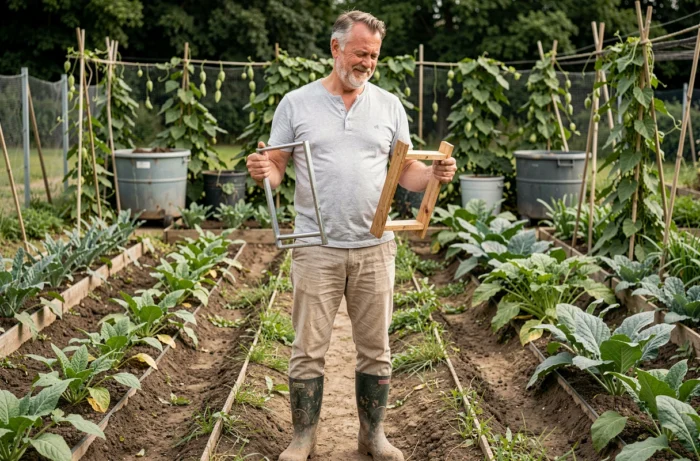
Reserve the grelinette for compacted areas
The trampled paths between the growing beds deserve targeted passes. The beds themselves, if protected by permanent mulch, do not always need to be decompacted. Focusing effort where the soil is truly compacted avoids unnecessarily disturbing the active biological life.
Grelinette and interchangeable tines: an underestimated criterion
On stony soil, a bent or broken tine renders the tool unusable. Models with interchangeable tines allow for the replacement of a single part without having to buy the whole tool.
This criterion significantly impacts the actual lifespan of the tool. A welded model, even robust, becomes waste as soon as a tine fails. A bolted model allows for piece-by-piece replacement for years.
- Bolted tines: unit replacement possible, slight mechanical play to monitor
- Welded tines: maximum rigidity, no repair possible in case of breakage
- Screwed tines with pin: compromise between strength and disassemblability
For regular use in permaculture or small-scale market gardening, the extra cost of a model with interchangeable tines pays off with the first replacement.
Ultimately, the choice of a grelinette relies on three concrete factors: soil texture, expected frequency of intervention, and the possibility of replacing worn parts. A three-tine model with curved tines and flared handles covers the majority of situations in an ecological vegetable garden. The rest depends on the terrain, not the catalog.