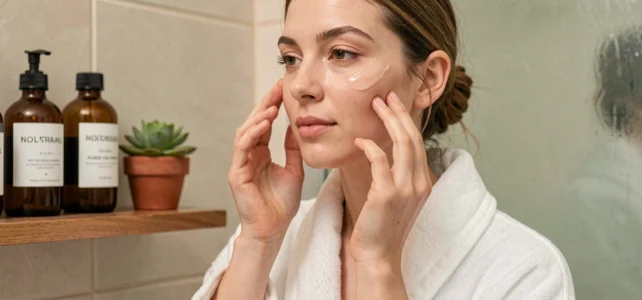
The natural cosmetics market is growing every year, driven by increasing distrust of synthetic formulations. Organic labels are multiplying, brands are reformulating, and consumers are navigating between ten-step routines and promises of results in four weeks. The reality is more nuanced: an effective natural beauty routine primarily depends on skin type, the number of products used, and the consistency of the actions.
Skin minimalism: why reducing the number of natural products makes a difference
The current trend is moving away from lengthy protocols. Several specialized sources now promote a streamlined routine centered around three to five products suited to skin type, rather than a stack of serums, essences, and masks. The idea is not to do less out of laziness, but to limit the risks of skin overload.
Sensitive or reactive skin does not tolerate the layering of actives well, even if they are natural. Applying a plant-based hyaluronic acid serum under a rosehip oil, followed by a shea butter cream, can saturate the epidermis and cause micro-inflammations. Tolerance varies from person to person: some oily skin types can handle daily double cleansing, while others see their sebum production go into overdrive.
The principle of skin minimalism is based on an honest diagnosis. Before purchasing an additional product, the question to ask is simple: what specific skin issue does this treatment address? If the answer remains vague, the product is unnecessary. Resources like beautenature.net allow exploration of targeted formulations without falling into accumulation.

Natural beauty routine for sensitive, oily, or reactive skin: adapting each step
A universal routine does not work because comedogenic coconut oil on oily skin will never yield the same results as on dry skin. Adapting each step to the skin profile is the only approach that stands the test of time.
Sensitive skin: less is more
The morning cleanse can be limited to a rinse with lukewarm water. Some minimalist routines recommend preserving the nocturnal sebum rather than stripping the skin upon waking. In the evening, a cleansing milk based on calendula or sweet almond oil is sufficient to remove impurities without altering the hydrolipidic film.
For hydration, chamomile or orange blossom hydrosols work well for reactive skin. Avoid pure essential oils on sensitive skin remains a basic precaution, even if the bottle bears an organic label.
Oily skin: regulate without stripping
The classic mistake is to multiply aggressive cleansings. An aloe vera or white clay gel regulates excess sebum without causing rebound effects. In the evening, a non-comedogenic jojoba cleansing oil dissolves makeup and pollution residues.
- Gentle cleanser morning and evening: aloe vera gel or white clay, without sulfates or synthetic fragrances
- Natural astringent toner: witch hazel hydrosol, which tightens pores without drying
- Light moisturizer: plant-based hyaluronic acid serum, which hydrates without a greasy effect
Reactive skin: test one product at a time
Introducing several new treatments simultaneously makes it difficult to identify which one causes a reaction. One new product every two weeks, first applied to a small area (inside the wrist or behind the ear), allows for spotting an intolerance before it spreads to the face.
Natural sun protection: the most underestimated gesture in a daily routine
Sun protection is rarely prioritized in a natural beauty routine, while available data points in another direction: UV rays penetrate windows and reach the skin even indoors or on cloudy days. Without sunblock, the benefits of a natural skincare routine quickly diminish.
Mineral filters (zinc oxide, titanium dioxide) are the most compatible option with a natural approach. They act as a physical barrier without penetrating the epidermis. Their main drawback is cosmetic: a slight white cast, especially on darker skin. Recent formulations have reduced this effect, but it persists in thicker textures.

Applying a mineral sun filter every morning, even when not going outside, protects against premature aging and pigmentation spots. This single gesture likely has more impact on skin quality in the long term than adding yet another serum.
Natural ingredients to watch: proven effectiveness or just a trend
Marketing around natural cosmetics sometimes blurs the line between genuinely effective actives and trendy ingredients. A few concrete guidelines help to sort through.
- Rosehip oil: recognized for stimulating collagen production, useful on scars and mature skin
- Shea butter: repairs the skin barrier, particularly suitable for dry or cold-dehydrated skin
- Plant-based hyaluronic acid: retains a significant amount of water in the epidermis, effective on most skin types
- Jojoba oil: composition similar to human sebum, well tolerated by oily skin
On the other hand, some highly publicized natural ingredients have not yet been the subject of solid large-scale studies. Available data does not always allow for conclusions about their long-term effectiveness. An organic label does not guarantee the effectiveness of an active, it certifies a mode of production.
The difference between a routine that works and a decorative routine often comes down to three factors: the choice of actives suited to one’s own skin type, consistency over several weeks, and the ability not to add another product with each new trend.