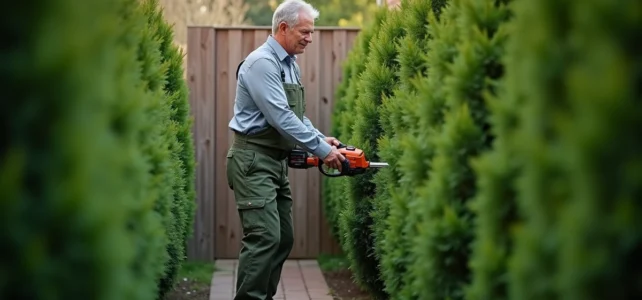
The thuja grows quickly, produces dense branches, and generates wood that hardens within a few weeks after spring growth. These three characteristics dictate the type of hedge trimmer suitable: a machine that is too weak struggles with thickness, a blade that is too short requires multiple passes, and a poorly balanced model tires the arms before finishing the length. Choosing the right hedge trimmer for thujas involves balancing cutting capacity, blade length, and autonomy.
Spacing of teeth and cutting capacity on thuja
The most underestimated technical data for a thuja hedge is the spacing of the teeth on the blade. This determines the maximum diameter of the branches that the device can cut in a single pass.
A thuja trimmed twice a year produces shoots with a moderate diameter. A tooth spacing of between 20 and 28 mm is sufficient in this case. If the hedge has not been trimmed for a year or more, hardened branches may exceed this threshold, causing the device to jam instead of cutting cleanly.
To find the best hedge trimmer for thujas, this spacing criterion should be checked as a priority, even before considering the power of the motor. A powerful motor combined with too narrow a spacing solves nothing: the branch does not fit between the teeth.
Another technical point: the blade length determines the speed of advancement along the length. A short blade (around 40 cm) is suitable for topiary or low hedges. For a thuja hedge that is often tall and long, a blade of 50 to 60 cm significantly reduces the number of passes and provides a more even cut on the surface.
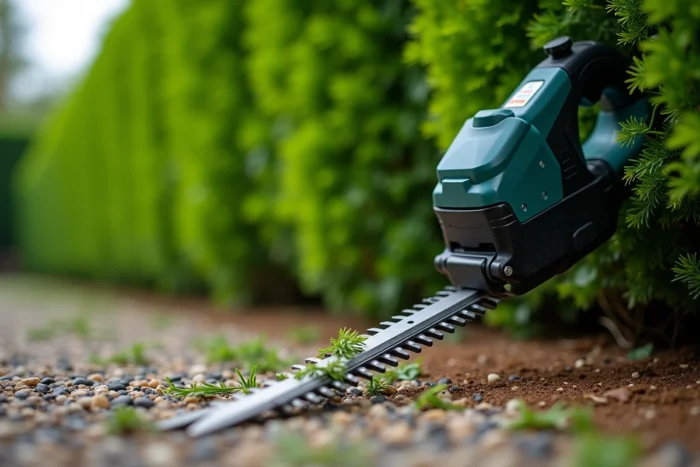
Battery or gas hedge trimmer for thujas: the real choice criterion
The question of the power source comes up consistently, but it is often posed from too general an angle. For a thuja hedge, the answer depends on a concrete parameter: the length of hedge to be covered in a single session.
Lithium-ion battery: the dominant option today
Current battery hedge trimmers provide sufficient cutting capacity for common thuja branches. The absence of a cord and fuel simplifies handling, and the noise level is significantly lower than that of a gas model.
The rising price of gasoline makes the gas model less cost-effective for regular domestic use. On a thuja hedge trimmed several times a year, the accumulated cost of fuel weighs more than before against the investment in a rechargeable battery. Professional analyses of landscaping equipment confirm that the transition to battery tools is accelerating, driven by both cost savings and ecological concerns.
Some municipalities also offer assistance for the purchase of electric or battery-powered gardening tools, with subsidy rates reaching up to 40% for low-income households and up to 70% for shared purchases (condominiums, community gardens). This financial lever is worth checking with your local authority before any purchase.
Gas: for very long lengths
The gas hedge trimmer retains an advantage in one specific area: unlimited autonomy as long as there is fuel. For thuja hedges exceeding a hundred meters, a gas model allows for uninterrupted work. The downside is the heavier weight, more pronounced vibrations, and maintenance of the engine (spark plug, air filter, mix).
For the majority of private gardens, a battery hedge trimmer with sufficient capacity meets the need without constraint. The gas option is justified for professional or semi-professional volumes.
Weight, balance, and ergonomics: what matters for long trimming
A hedge trimmer is held at arm’s length, often at height. On a thuja hedge that exceeds two meters, muscle fatigue becomes the limiting factor well before the machine’s autonomy.
- The total weight (including battery for cordless models) determines how long the cut remains precise. Beyond a certain threshold, the arms tremble and the cutting line wavers.
- The weight distribution between the front and back of the machine is as influential as the gross weight. A well-balanced hedge trimmer can be handled longer than a lighter but poorly balanced model towards the blade.
- The rotating handle (pivoting in several positions) facilitates cutting on the sides and top of the hedge without straining the wrist. For tall thujas, this function reduces the need to resort to a pole model.
- An anti-vibration system reduces fatigue on the forearms during extended sessions.
Comfort of use does not appear on any standardized technical data sheet. The only reliable method remains to handle the device before purchase or to rely on comparative tests published by independent organizations.

Frequency of trimming thujas and blade wear
The thuja produces rapid growth in spring and a second, more moderate growth at the end of summer. Two trims per year represent the minimum to maintain a controlled volume: the first after the spring growth (taking into account the bird nesting period, to be avoided from March 15 to July 31 according to the recommendations of the French Office for Biodiversity), and a second at the end of summer or early autumn.
This frequency implies regular use of the blade. Thuja branches contain a resin that clogs the teeth and accelerates oxidation if the blade is not cleaned after each use. A wipe with a cloth soaked in resinous product and light lubrication significantly extends the blade’s lifespan.
A poorly maintained blade crushes the branches instead of cutting them. The thuja reacts poorly to a crushed cut: the tips turn brown, and unlike some broadleaf trees, the thuja does not regrow on old wood. A browned area on a thuja remains permanently brown, making the quality of the cut even more critical than with other species.
The choice of a hedge trimmer for thujas boils down to three verifiable priorities: a tooth spacing suitable for the diameter of the branches, a blade long enough for the length to be covered, and a weight compatible with use at height. The power source (battery or gas) then depends on the length of the hedge and the budget, incorporating the cost of use over several seasons.