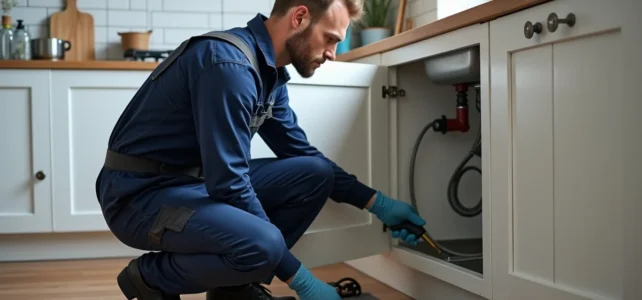
A clog in a pipe rarely forms all at once. Residues of grease, soap, limescale, and hair accumulate on the inner wall of the pipe until they reduce the diameter of water passage. When the flow slows down or stops, the common reflex is to pour a chemical product or to push a large drain snake.
These actions may work on a superficial clog, but they ignore the real cause of the blockage and pose concrete risks to the pipes.
Diameter and configuration of the network: what determines the unclogging method
Not all pipes can be unclogged in the same way. The diameter of the pipe, the number of bends, the nature of the material (PVC, old cast iron, stoneware), and the depth of the blockage dictate the choice of tool. A manual snake is suitable for a sink trap but becomes ineffective in an underground network with directional changes.
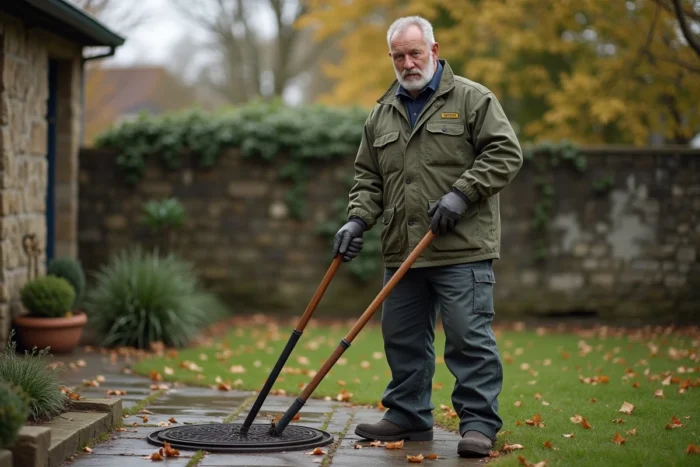
Professionals adapt their equipment to the actual configuration of the network. On small diameters, an overly bulky camera risks getting stuck. On outdoor or sewer networks, a longer rod system allows reaching the blockage without forcing. This logic of tool-network compatibility is absent from DIY, where the same snake is used everywhere, regardless of the context.
In old buildings, the constraints are even more pronounced. Tight bends, fragile cast iron pipes, and narrow urban access require tools designed for these situations: compact hydro-cleaning trucks, nozzles suited for turns, calibrated pressure to avoid cracking the pipe. Deciding to call a professional plumber allows access to this level of diagnosis before any mechanical action.
Chemical drain cleaners and pipes: the invisible damage
The drain cleaning products sold in stores contain highly corrosive agents (caustic soda, sulfuric acid). Their principle is simple: dissolve the clog through a chemical reaction. The problem is that this reaction is not limited to the clog.
On PVC pipes, the heat released by the reaction can deform the tube. On old cast iron, already weakened by corrosion, the product accelerates internal degradation. The chemical drain cleaner addresses the symptom but damages the pipe, which encourages the formation of new clogs in the medium term.
A professional plumber uses mechanical or hydraulic methods (professional snake, hydro-cleaning) that clear the blockage without attacking the wall. The difference lies in the duration: mechanical unclogging preserves the integrity of the network, whereas repeated use of chemical products gradually reduces the lifespan of the pipes.
Camera inspection: a diagnosis, but also a technical proof
Inspection by endoscopic camera is not only used to locate a clog. It produces a timestamped video recording that shows the internal state of the network, the exact position of the defect, and the nature of the blockage (roots, limescale, pipe settling).
This document has concrete value in several situations:
- In a dispute between co-owners or with a property manager, it proves the origin of the problem and identifies the affected section of the network.
- For a claim with a home insurance, it serves as a technical supporting document that photos alone cannot replace.
- Before renovation work, it allows assessing the actual condition of the pipes and anticipating a partial replacement rather than a more costly emergency intervention.
This “diagnose then justify” logic transforms unclogging into a traceable and usable intervention by third parties. A snake used blindly produces no reusable data.
Professional drain unclogging: what the intervention really covers
A professional plumber does not just restore the flow. The intervention generally follows a precise technical sequence.
First, a visual or camera diagnosis identifies the location and nature of the clog. This step avoids working blindly and guides the choice of method. Next, the actual unclogging uses the tool suited to the context (electric snake, high-pressure hydro-cleaning, suction). Finally, a post-intervention check confirms that the pipe is clear along its entire length.
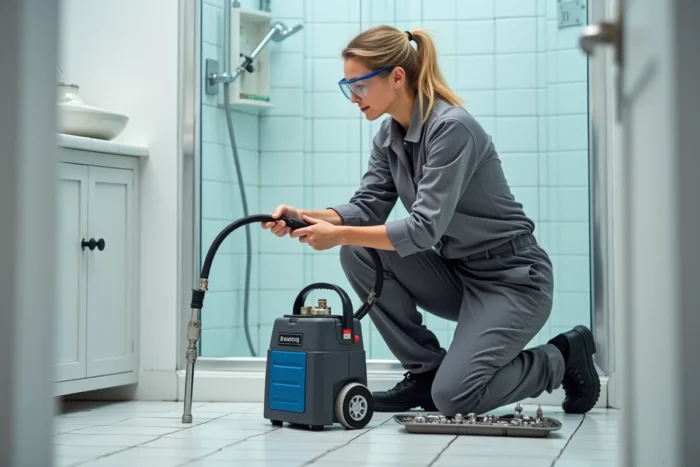
The professional adjusts the water pressure to the material of the pipe, which protects fragile pipes while remaining effective on stubborn clogs. This calibration is impossible with a domestic high-pressure cleaner, whose pressure is neither finely adjustable nor designed for drainage pipes.
When the clog reveals a structural problem
A recurring clog in the same spot often signals a defect in the network: reverse slope, misaligned joint, infiltrated root, localized settling. Unclogging without investigating amounts to treating the consequence without addressing the cause.
The craftsman who identifies this type of defect can propose a targeted repair before the situation escalates into water damage. This ability to transition from troubleshooting to structural diagnosis distinguishes professional intervention from improvised unclogging.
A well-maintained network of pipes can operate for decades without major issues. When a clog forms, the pertinent question is not just how to remove it, but why it formed in that specific location. It is this second question that justifies the equipment and expertise that the plumbing aisle of a DIY store does not provide.