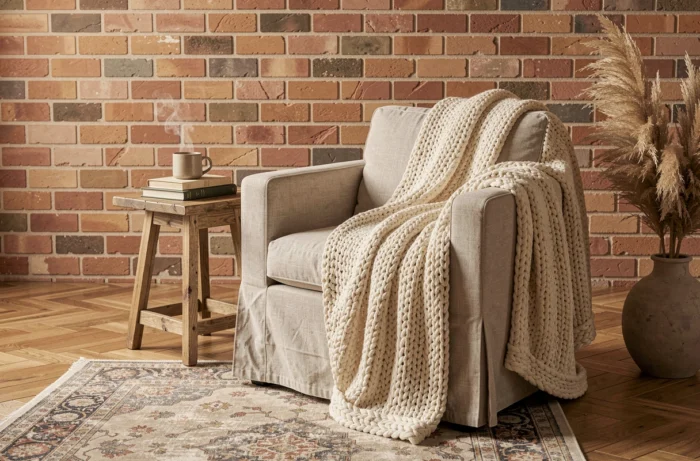
Transforming a house into a warm cocoon is no longer just about piling blankets on a sofa. Recent trends show a shift: cocooning now incorporates raw materials, a biophilic approach, and light management designed for physiological comfort. What levers create a real change in atmosphere, and which are merely decorative accessories?
Natural materials and visible sustainability: what differentiates a durable cocooning interior
Most decor guides recommend adding cushions, candles, and a few green plants. These elements contribute to the ambiance, but they remain superficial if the very structure of the room does not follow suit.
Cocooning as it is defined today relies on materials with a raw or weathered appearance: reclaimed wood, exposed stone, cork, unbleached linen. These surfaces create a perception of warmth even before one touches anything.
| Material | Visual Effect | Tactile Effect | Sustainability |
|---|---|---|---|
| Raw or reclaimed wood | Warmth, depth | Irregular grain, warm touch | Very high |
| Natural linen (textile) | Softness, lightness | Flexible, slightly textured | High |
| Cork (wall or floor covering) | Honey tone, organic | Flexible, insulating to the touch | High |
| Natural stone | Minerality, grounding | Cool yet reassuring | Very high |
| Woven fibers (rattan, jute) | Texture, relief | Rough, artisanal | Medium to high |
The interest in these materials goes beyond decoration. A wall of raw wood or a cork floor alters the acoustics of a room, absorbs sounds, and reduces reverberation. The comfort of a cocooning space also comes from the relative silence it provides.
To explore other avenues around interior design, you can consult the Le Scope website, which gathers resources on housing and home.
Light and biological rhythm: going beyond simple dim lighting
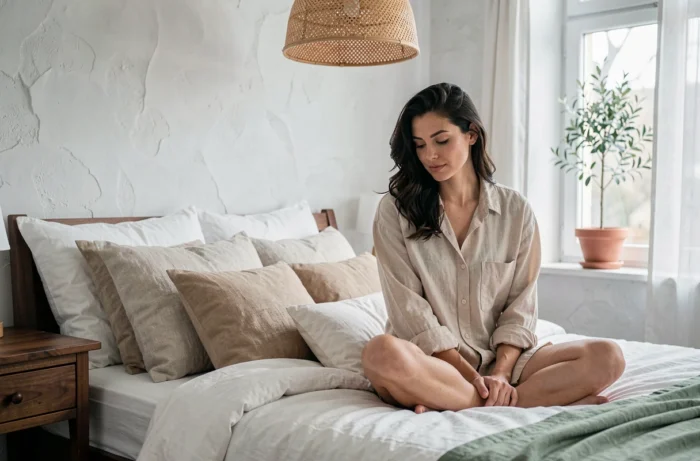
Competing content often stops at one piece of advice: prefer warm light. This is a starting point, but light management in a cocooning interior touches on physiological well-being.
The color temperature of a bulb is measured in kelvins. Below 2,700 K, the light leans towards amber and promotes melatonin production in the evening. Above 4,000 K, it stimulates alertness. An effective cocooning living room combines these two registers according to the time of day.
Three levels of light to layer
- A soft general lighting (ceiling fixture or pendant with dimmer) set below 2,700 K for evenings, enveloping the room without creating harsh shadow areas.
- Task lighting (reading lamp, wall sconce) directed towards activity zones, to avoid relying on a too-powerful central light.
- Decorative light accents (low-energy LED garlands, lanterns) that create visual landmarks and enhance the feeling of intimacy.
A common mistake is to multiply candles without another light source. The result is an under-lit space that strains the eyes. Visual warmth comes from the contrast between lit areas and soft shadow zones, not from uniform darkness.
Biophilic design: when the cocoon draws inspiration from the living
The term “biophilic” refers to a design principle that integrates living natural elements or those evoking nature into interior architecture. Recent trends go well beyond a simple potted plant placed on a shelf.
Trend sources for housing describe an increasing reliance on large structural plants and living walls as elements that redefine the space itself. A large fiddle leaf fig or a climbing philodendron alters the perception of a room’s volume as much as a piece of furniture.
Organic shapes in furniture
Straight lines and sharp angles give way to rounded shapes and organic curves in sofas, coffee tables, and light fixtures. This trend is not purely aesthetic: a rounded armchair back better supports a seated posture, and a table with curved edges facilitates movement in a living room.
Pairing a sofa with enveloping shapes, a natural fiber rug, and one or two large plants is enough to anchor a room in a cocooning atmosphere without resorting to an accumulation of accessories.
Cocooning colors: warm palettes and earthy tones
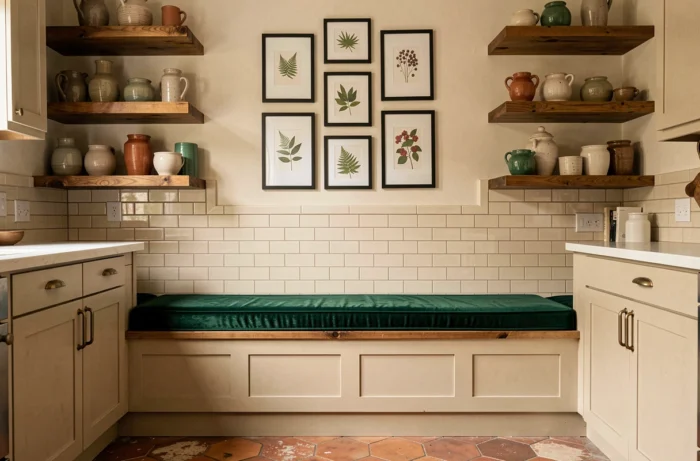
The choice of colors remains the quickest lever to change the atmosphere of a room. The palettes that work for a cocooning interior are organized around two families.
- Earthy tones (terracotta, taupe, ochre, coffee brown) provide a sense of enveloping. They work particularly well on an accent wall or in a total look in a small room.
- Warm neutrals (off-white, beige, greige) serve as a backdrop and allow natural light to circulate without absorbing too much brightness.
- Deep accents (sage green, petrol blue) add depth without cooling the space, provided they are limited to one wall or textiles.
On the other hand, saturated cool colors (bluish gray, pure white) produce the opposite effect: they increase the perceived distance between surfaces and reduce the feeling of a cocoon. A pure white paint on all four walls of a living room is one of the most counterproductive choices for a cocooning atmosphere.
The combination of raw wood, linen, and earthy palette forms the most reliable foundation for a warm interior that does not go out of style in a season. Handcrafted objects with imperfect finishes, handwoven textiles, and unvarnished wood furniture reinforce this coherence by adding a tactile dimension that smooth and industrial surfaces cannot replicate.