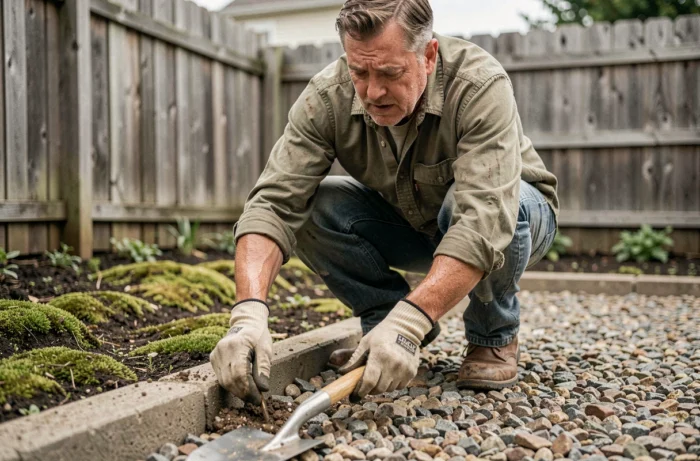
Removing gravel embedded in a garden or yard soil is not just about shoveling. The grain size of the material, the presence or absence of degraded geotextile, and the soil-gravel mixture accumulated over the years radically change the method to be employed. Here, we detail the approaches that work on the ground, starting with the step that most guides overlook.
On-site sorting of gravel: the economic lever before handling
Before filling bags with rubble, one must think about disposal. Properly sorted gravel (free of soil, roots, and geotextile debris) is accepted for free or at a low cost by most waste disposal sites and recycling platforms. In contrast, a gravel-soil-textile mixture is significantly more expensive to remove.
On-site sorting transforms an expense item into real savings. Specifically, this means separating usable gravel from contaminated substrate before any loading. Clean gravel can be reused as backfill, as a sub-layer for pathways, or for drainage, or even given to a neighbor. Institutional platforms like those of ADEME or certain local authorities guide individuals towards channels for the recovery of sorted inert rubble.
We recommend starting by testing a small area: if the gravel separates easily from the soil with a rake or sieve, manual sorting remains viable. If the mixture is compact and old, mechanical screening will be necessary, or one must accept a more expensive mixed disposal. For removing gravel from the garden with Bon Jardinier, several detailed methods allow you to adapt the strategy to your configuration.
Gravel mixed with soil: screening and extraction by layers
This is the most common case in older yards. Gravel has migrated into the soil, organic matter has infiltrated between the stones, and the original geotextile has fragmented into plastic scraps mixed with the substrate. Shoveling this mixture amounts to moving soil loaded with stones without solving anything.
Construction sieve and screening technique
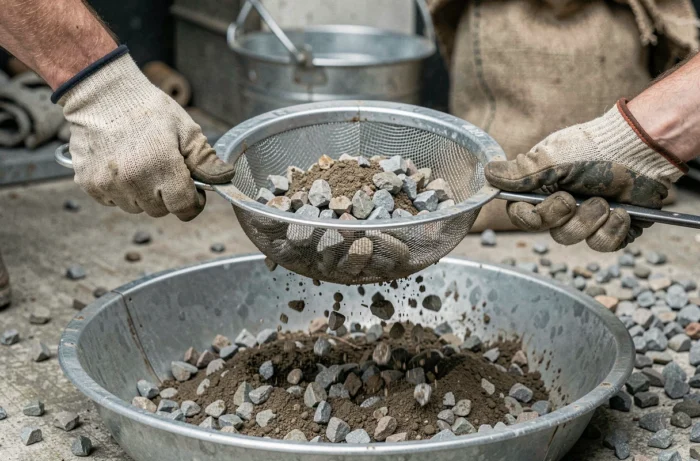
A sieve with a mesh suitable for the gravel grain size (often between 10 and 20 mm for standard decorative gravel) effectively separates the stones from the earthy substrate. Work is done in one-meter-wide strips, excavating with a flat iron or spade to the depth of gravel penetration.
- Excavate in layers of a few centimeters, never deeply in a single pass, to avoid further mixing the layers
- Sift each shovelful over a wheelbarrow or tarp, recovering clean gravel on one side and soil on the other
- Remove geotextile fragments as you go: they clog the sieve and contaminate the sorted gravel batch
- Lightly moisten the soil the day before if the earth is very dry and powdery, which limits dust and facilitates separation
Properly screened gravel finds a second life in drainage or backfill. The recovered soil, free of stones, can be spread and amended to create a planting area.
Extraction without screening: when to abandon sorting
If the gravel is very fine (type rolled gravel less than 8 mm) and deeply mixed with clay soil, screening becomes a disproportionately patient task. In this case, we recommend the raw extraction of the mixture over the entire thickness concerned, followed by disposal as mixed rubble. The disposal cost will be higher, but the time saved in labor more than compensates.
Removal of gravel on intact geotextile: quick method
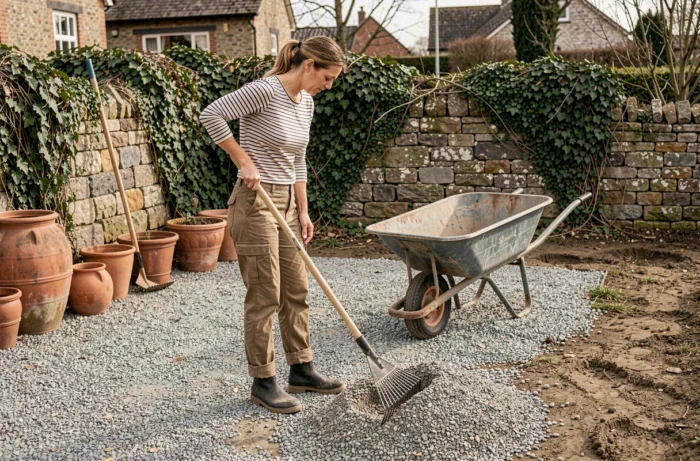
When the geotextile under the gravel is still in good condition, removal becomes much simpler. The fabric serves as a sliding plane to gather the gravel into a pile. Pull the textile from one edge while pushing the gravel towards the center, then load it directly with a shovel.
This method works on small surfaces. In a large yard, the weight of the gravel prevents pulling the fabric in one go. One must then cut the geotextile into strips one to two meters wide with a cutter and treat each strip separately.
Beware of the classic trap: a geotextile that appears intact on the surface may be weakened underneath by UV rays filtered through the gravel or by roots that have perforated it from below. Testing the fabric’s strength on a corner before pulling on it prevents ending up with plastic scraps scattered throughout the yard.
Tools and logistics for removing gravel from a yard
The choice of tools depends on the surface area and volume to be processed. In a small yard, the trio of shovel-rake-wheelbarrow is sufficient. Beyond a few square meters of thick gravel, renting a mini-excavator radically changes the game in terms of fatigue and time.
- Rubble rake (spaced teeth) for raking without collecting fine soil
- Square shovel rather than spade for loading gravel without sinking into the ground
- Mason’s sieve or metal grid mounted on a frame for manual screening
- Woven rubble bags (big bag type) rather than garbage bags, which puncture immediately under the weight of the stones
- Mini-excavator with a digging bucket for surfaces larger than ten square meters
A big bag filled with gravel is very heavy and requires access for a crane truck or lifting equipment. Plan the storage location and evacuation logistics before starting the project, not after.
Cleanly removed and sorted gravel by size finds buyers easily. Websites for donations between individuals, neighboring projects, or local landscapers regularly collect used gravel for backfill or drainage purposes. The reuse channel for inert aggregates is quickly structuring, and throwing clean gravel mixed with other waste amounts to wasting a resource that has value.