
Pregnancy lasts on average forty weeks of amenorrhea, divided into three trimesters with distinct medical stakes. Each trimester corresponds to specific stages of embryonic and then fetal development, and to a schedule of mandatory prenatal consultations. Understanding this schedule allows for anticipating examinations, adapting one’s diet, and spotting signals that justify a prompt medical opinion.
CMV Screening in the First Trimester: The New Recommendation from HAS
Since July 2026, the Haute Autorité de santé recommends systematic CMV screening for pregnant women whose serological status is unknown or negative. The serology should be performed before or very early in the pregnancy, and then repeated every four weeks until 13-14 weeks of amenorrhea.
The cytomegalovirus is a viral infection that is often asymptomatic in adults but can cause neurological sequelae in the fetus in the case of maternal primary infection. Until this recommendation, screening was not systematic in France.
In the case of confirmed primary infection during the two months preceding pregnancy or in the first trimester, HAS recommends a dedicated consultation, a quick discussion of antiviral treatment, and referral to an expert team (Multidisciplinary Prenatal Diagnosis Center or perinatal network). This change concretely modifies the content of the first prenatal consultation: be sure to request this serology if your healthcare professional does not mention it.
Detailed information on this follow-up and other prenatal examinations is available on the pregnancy section on Le Portail de la Santé, which centralizes medical guidelines trimester by trimester.
Mandatory Prenatal Consultations: Schedule and Key Examinations
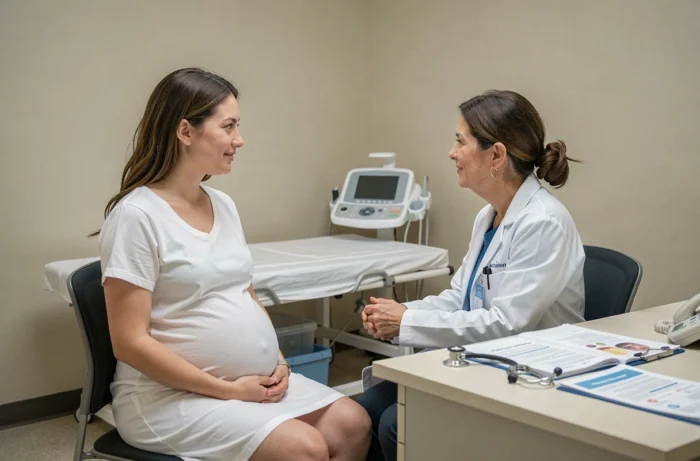
Pregnancy follow-up in France includes seven mandatory prenatal consultations, the first of which should take place before the end of the third month. This initial consultation is the longest: it includes a complete clinical examination, the declaration of pregnancy, and the prescription of the first blood tests (blood type, serologies, blood sugar).
Biological Examinations Trimester by Trimester
In the first trimester, tests focus on toxoplasmosis, rubella, HIV, hepatitis B, and now CMV. The serology for toxoplasmosis is repeated every month if the future mother is not immune.
The screening for Down syndrome combines a blood test (serum markers) and an ultrasound measurement of nuchal translucency, performed between 11 and 13 weeks of amenorrhea. This screening is offered, not imposed.
- First ultrasound (between 11 and 14 weeks): dating of the pregnancy, number of embryos, measurement of nuchal translucency
- Second ultrasound (between 20 and 25 weeks): complete morphology of the fetus, location of the placenta, amount of amniotic fluid
- Third ultrasound (between 30 and 35 weeks): position of the fetus, weight estimation, growth verification
Each ultrasound has a specific medical purpose. None replaces the other, and a delay of several weeks can reduce the reliability of certain measurements.
Preeclampsia During Pregnancy: A Risk to Monitor from the First Trimester
Preeclampsia combines high blood pressure and the presence of proteins in the urine, usually after 20 weeks of amenorrhea. It can lead to serious complications for the mother (kidney damage, liver damage, seizures) and for the fetus (growth retardation, prematurity).
Early screening relies on measuring blood pressure at each consultation and on testing for proteinuria using a urine dipstick. Certain factors increase the risk: a history of preeclampsia in a previous pregnancy, chronic hypertension, diabetes, multiple pregnancies, or a first pregnancy after 40 years.
Current recommendations suggest that for women at identified risk, low-dose aspirin should be prescribed starting in the first trimester. This preventive treatment must be initiated before 16 weeks of amenorrhea to be effective. The decision is up to the doctor or midwife who is providing follow-up care.

Perinatal Health in France: What Recent Data Reveals
A bulletin from Santé publique France published in July 2026 presents a mixed picture. Some indicators are improving: reduction in certain forms of prematurity and a decrease in smoking during pregnancy in 2024. The decline in smoking among pregnant women is a positive signal, as smoking is directly linked to intrauterine growth retardation and prematurity.
At the same time, the bulletin notes a rising trend in infant mortality and persistent regional disparities. Some areas face difficulties in accessing maternity services, a reduced number of perinatal health professionals, and social vulnerabilities that weigh on pregnancy follow-up.
This data reminds us that the quality of follow-up also depends on geographical access to care. For women far from a maternity unit, teleconsultation with a midwife or gynecologist can complement in-person follow-up, but cannot replace it for clinical examinations and ultrasounds.
Nutrition and Pregnancy: The Decisions That Really Matter
Folic acid (vitamin B9) remains the only supplement systematically recommended, ideally from the time of pregnancy planning and throughout the first trimester. It reduces the risk of neural tube defects.
For everything else, dietary rules boil down to a few concrete decisions:
- Avoid raw milk cheeses, raw charcuterie, and smoked fish to limit the risk of listeriosis
- Thoroughly wash fruits and vegetables, and avoid raw or rare meat if the toxoplasmosis serology is negative
- Maintain sufficient intake of iron and calcium through regular diet, with supplementation prescribed only in cases of documented deficiency through a blood test
- Completely eliminate alcohol, with no consumption threshold considered safe for the fetus
Vitamin D supplementation is discussed on a case-by-case basis with the healthcare professional, depending on lifestyle and season. Systematic prescription is not the norm.
Pregnancy follow-up has gained precision in recent years, with the addition of CMV screening and better stratification of preeclampsia risk from the first trimester. These advances do not change the basic principle: each prenatal consultation has a defined medical purpose, and postponing an appointment means delaying a screening window that is not always recoverable.